

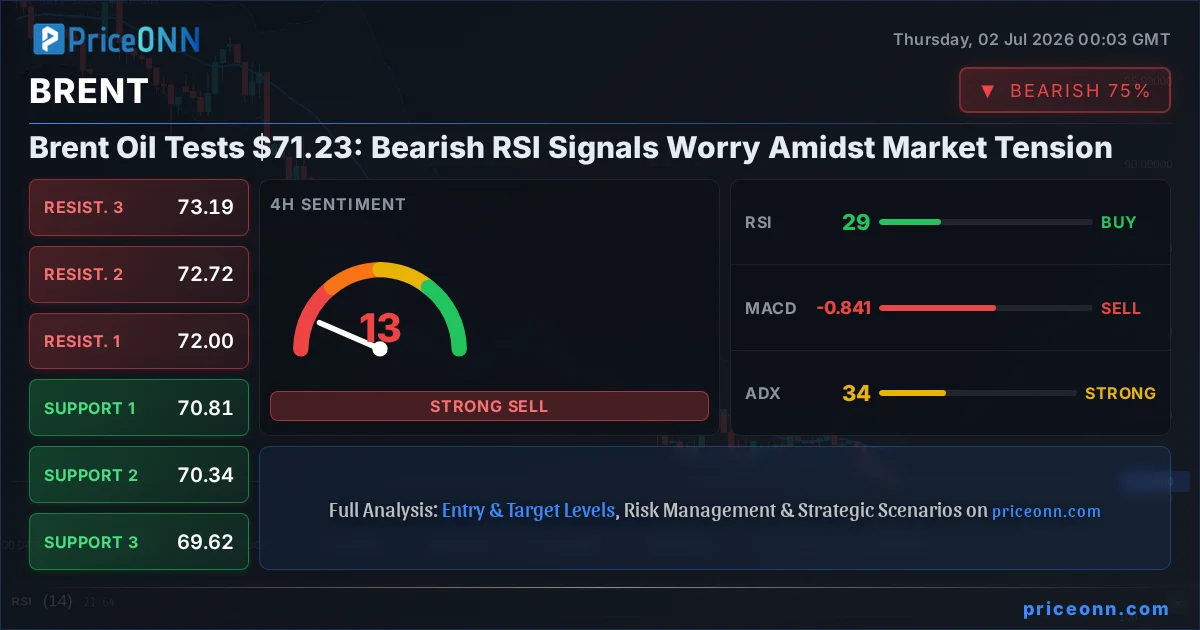
The tug-of-war in the oil markets is palpable, with Brent crude currently finding itself at a critical juncture around the $71.23 mark. This price point is more than just a number; it's a battleground where bulls and bears are fiercely contesting control. Today's analysis delves into the intricate technical landscape of Brent, dissecting the signals flashing across multiple timeframes to understand the prevailing market sentiment and potential future direction. We'll navigate the data, from the overbought/oversold indicators to the strength of existing trends, to paint a clear picture for traders eyeing this volatile energy commodity.
- The 1-hour RSI reading of 33.19 signals bearish pressure, approaching oversold territory.
- Brent crude is trading at $71.23, with immediate support at $70.96 and resistance at $71.33 on the 1H chart.
- The ADX at 42.36 on the 1H timeframe indicates a strong downtrend is in play, suggesting momentum is behind the sellers.
- Goldman Sachs' recent warning of a potential 2027 oil market surplus adds a fundamental layer of caution to the bearish technical outlook.
As Levent Yazıcı, I approach these markets not just through the lens of price action, but by understanding the underlying infrastructure and industrial fundamentals that truly drive supply and demand. The recent dip in Brent below $72 is not occurring in a vacuum. It's a reflection of broader global economic currents, inventory levels, and geopolitical considerations that, when combined, paint a complex picture. This analysis will unpack these elements, providing a systematic view of where Brent stands and what to anticipate next.
The Bearish Case: Signs of Weakness Mount
The technical indicators are currently flashing cautionary signals for Brent crude, leaning towards a bearish outlook, especially when examining the shorter timeframes. On the 1-hour chart, the Relative Strength Index (RSI) stands at 33.19. While not yet in the deeply oversold territory below 30, this reading clearly indicates that selling pressure is intensifying. This suggests that the momentum behind any recent upward moves has significantly waned, and bears are gaining traction. Coupled with this, the MACD histogram is negative and positioned below its signal line, reinforcing the bearish momentum observed in the RSI. The Stochastic Oscillator, with %K at 16.34 and %D at 14.33, is firmly in oversold territory, indicating that the selling may be extended but also hinting at a potential for a short-term bounce if buyers step in.
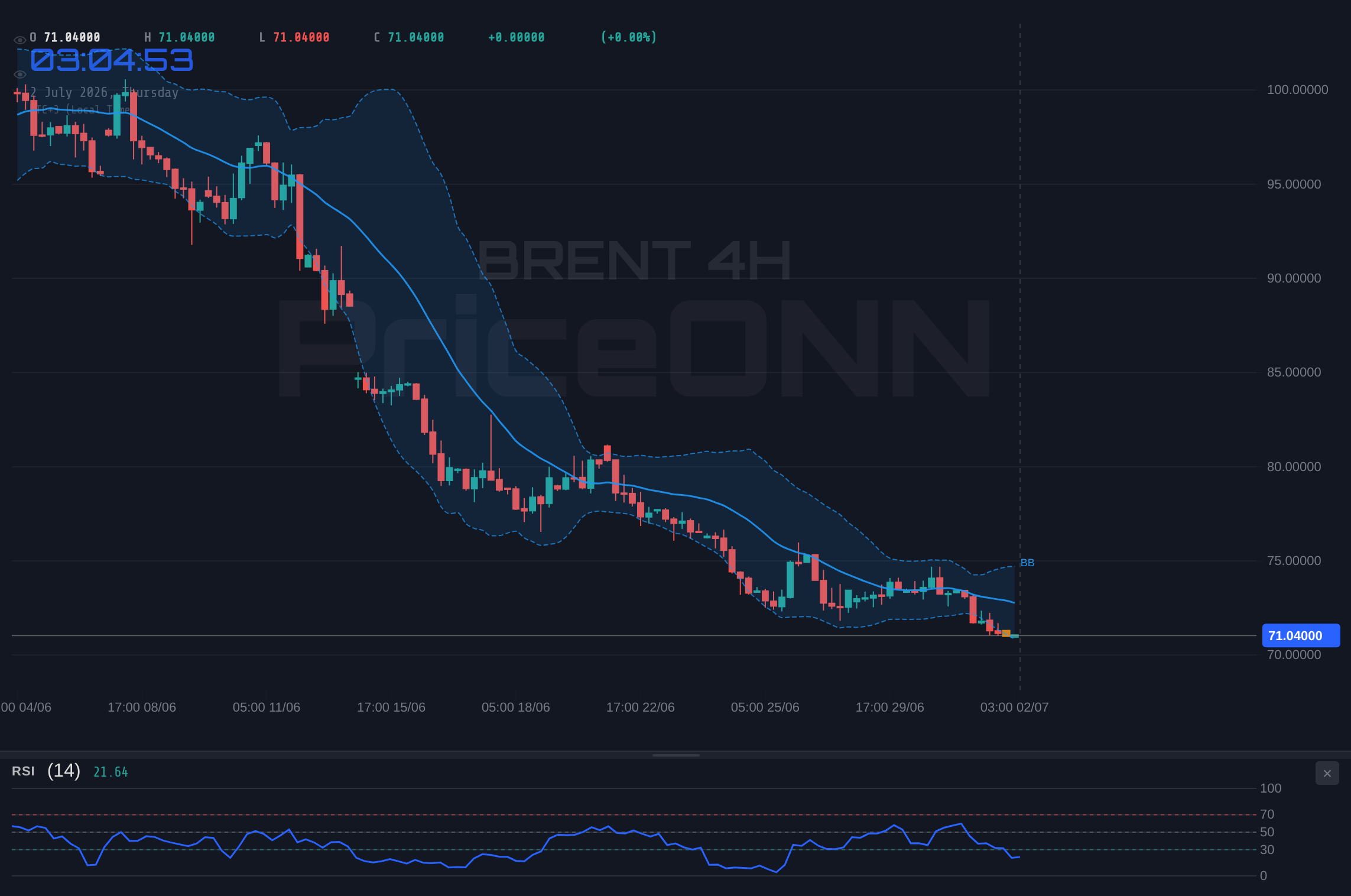
However, the strength of the current trend cannot be ignored. The Average Directional Index (ADX) on the 1-hour chart reads 42.36, which signifies a very strong trend. When the ADX is this high, it implies that the market is not merely fluctuating but is in a robust directional move. Given the bearish leanings of other indicators, this strong ADX reading strongly suggests that the prevailing trend is downwards. The Bollinger Bands on the 1-hour chart are also positioned below the middle band, further confirming the bearish sentiment and indicating that prices are trading near the lower end of their recent range. The 4-hour chart echoes this bearish sentiment, with RSI at 30.1, also in oversold territory, and a similarly strong ADX of 34.42. The Stochastic on this timeframe is even deeper in oversold conditions (K=6.06, D=18.49), suggesting a potential for a snap-back rally, but the overall trend remains firmly downwards according to the ADX.
The daily chart, while showing RSI at 24.85 – a classic oversold signal – also presents a strong bearish trend with an ADX of 39.63. The Stochastic on the daily chart is deeply oversold as well (K=11.07, D=10.53). This confluence of oversold conditions across timeframes, combined with strong trend strength indicators, paints a picture of a market under significant selling pressure. While oversold conditions can sometimes precede a reversal, they can also persist for extended periods in strong downtrends. The current price of $71.23 is below the middle Bollinger Band on the daily chart, and the MACD is negative. All these factors align to support a bearish thesis, suggesting that further downside is possible if key support levels are breached.
The Bullish Counter-Argument: Finding Opportunity in the Dip?
Despite the prevailing bearish signals, there are always arguments to be made for a bullish reversal, particularly when indicators reach extreme oversold levels. The daily RSI at 24.85 and the Stochastic values (K=11.07, D=10.53) are screaming 'oversold'. Historically, such extreme readings have often preceded significant price bounces. Traders looking for value might see this as an opportune moment to enter long positions, anticipating a rebound. The 1-hour chart, while showing bearish momentum, also has Stochastic in oversold territory, which could signal a short-term upward correction. Similarly, on the 4-hour chart, the Stochastic is also oversold, potentially indicating a near-term bounce.
Furthermore, the MACD on the 4-hour timeframe is showing positive momentum and is above its signal line, which contradicts the bearish narrative from the RSI and Stochastic on that same timeframe. This divergence can sometimes be an early warning sign that the bears are losing their grip. While the ADX on all timeframes (1H: 42.36, 4H: 34.42, 1D: 39.63) indicates a strong trend, the *direction* of that trend is what needs confirmation. If a strong bullish catalyst emerges, these strong trend indicators could simply amplify an eventual upward move. The fact that Brent is trading around $71.23, with immediate support levels like $70.96 on the 1H chart holding, could be interpreted as a sign of resilience. A failure of these support levels to break could encourage buyers to step in, looking to capitalize on the perceived undervaluation.
Looking at the broader market context, while the DXY (Dollar Index) is currently rising (at 101.44), which typically pressures commodities like oil, sustained strength in equities like the S&P 500 (at 6572.87) could offer some underlying support. If the stock market continues its upward trajectory, it might suggest a degree of risk appetite that could eventually spill over into commodities, even if temporarily. The key for bulls will be to defend immediate support levels and push prices back above the middle Bollinger Band on the 1H and 4H charts, breaking the negative momentum observed in the MACD and RSI. A decisive move above the 1H resistance at $71.33 would be the first sign that the bearish sentiment might be shifting.
The Verdict: Navigating the Bearish Trend with Caution
When weighing the evidence, the bearish case for Brent crude currently holds more weight, primarily due to the confluence of strong trend indicators and oversold conditions persisting across multiple timeframes. The ADX readings of 42.36 on the 1H, 34.42 on the 4H, and 39.63 on the 1D all point to a strong, established downtrend. While extreme oversold readings on the RSI and Stochastic can signal potential reversals, they can also persist in powerful trends, leading to further downside before any significant bounce occurs. The fact that prices are trading below the middle Bollinger Bands on all observed timeframes reinforces this bearish outlook.
The immediate support level at $70.96 on the 1H chart is critical. A break below this level, confirmed by sustained trading and continued negative MACD momentum, would likely signal further declines towards the next support at $70.81 on the 4H chart. On the resistance side, the 1H level at $71.33 is the first hurdle for any potential bullish correction. A sustained move above this, coupled with a shift in RSI and MACD readings, would be necessary to challenge the bearish narrative. However, given the strength of the current downtrend, breaking through these resistance levels might prove challenging without a significant shift in market fundamentals or sentiment.
Adding to the cautious outlook is the recent commentary from Goldman Sachs, warning of a potential oil market surplus in 2027. Such fundamental headwinds, even if looking further out, can weigh on market sentiment and limit upside potential in the near term. While speculative traders might look to capitalize on short-term bounces from oversold conditions, the broader technical picture suggests that the path of least resistance for Brent crude remains downwards for now. Therefore, any bullish positions should be approached with extreme caution, tight risk management, and clear invalidation levels. The market is currently favouring the bears, and until clear signals of a trend reversal emerge, prudence is advised.
Navigating the Levels: What to Watch
For traders observing Brent crude, the 1-hour chart presents immediate action. Support is found at $70.96 and $70.81, while resistance looms at $71.33 and $71.55. A decisive break below $70.81 could open the door to further declines. Conversely, a sustained push above $71.55 might signal a short-term reprieve for the bulls. On the 4-hour chart, the key support level to watch is $70.81, with a more significant floor at $70.34. Resistance is set at $72.00 and $72.72. The daily chart provides the longer-term perspective, with support at $72.34 and $71.40, and resistance at $74.45 and $75.62. The current price of $71.23 sits precariously close to the 1-hour support, making the immediate trading action crucial.
The macroeconomic backdrop also plays a significant role. The rising DXY, currently at 101.44, adds pressure on dollar-denominated commodities like Brent. A strengthening dollar typically makes oil more expensive for holders of other currencies, potentially dampening demand. While the S&P 500 is showing some strength at 6572.87, its own technical setup, particularly on the daily chart, suggests potential headwinds. Any significant risk-off sentiment in equities could further exacerbate the downward pressure on oil prices. Traders must remain attuned to these correlations, as they can significantly influence the trajectory of Brent crude.
The interplay between technical signals and fundamental news is crucial. While the technicals suggest a bearish trend, news like Goldman Sachs' warning about future supply gluts can reinforce this sentiment. Conversely, unexpected geopolitical tensions or supply disruptions could rapidly shift the narrative, even if the technicals are bearish. It's this dynamic interplay that requires constant monitoring. For now, the evidence points to caution, with bears holding the reins, but the oversold conditions offer a glimmer of hope for a potential bounce, provided key levels hold.
The Infrastructure Angle: Supply Dynamics and Future Outlook
From an infrastructure perspective, the current price action in Brent oil is influenced by a complex interplay of global production capacities, refining operations, and transportation logistics. While not explicitly detailed in the live data, understanding the underlying supply chain is vital. For instance, reports of increased oil inventory rebuilds, as hinted at by Goldman Sachs' surplus concerns, suggest that current production levels might be exceeding immediate demand, or that future demand expectations are being revised downwards. This is particularly relevant when considering the global energy transition, where long-term demand forecasts are subject to significant uncertainty due to shifts towards renewable energy sources. The operational status of key pipelines, refinery utilization rates, and OPEC+ production quotas all contribute to the supply-side dynamics that ultimately influence price.
The geopolitical context cannot be overstated. Events in major oil-producing regions, such as the Middle East or Eastern Europe, can trigger immediate price spikes due to fears of supply disruptions. While the current data doesn't highlight specific geopolitical events, the inherent volatility in these regions remains a constant background risk factor. If tensions were to escalate, even with current bearish technical signals, we could see a rapid price reversal as traders factor in potential supply shocks. This highlights the importance of monitoring news flow alongside technical analysis, as fundamental catalysts can quickly override technical patterns.
Looking ahead, the market will be closely watching inventory reports, OPEC+ meeting outcomes, and any significant geopolitical developments. From an infrastructure standpoint, investments in new exploration, the maintenance of existing fields, and the development of alternative energy infrastructure all play a role in shaping future supply and demand balances. While the current technicals point to a bearish short-to-medium term outlook for Brent at $71.23, the long-term picture remains contingent on these broader industrial and geopolitical factors. The strength of the trend indicated by the ADX suggests that any bullish reversal would require a significant shift in these underlying fundamentals.
Trade Scenarios: Charting the Path Forward
Bearish Scenario: Downtrend Continues
65% ProbabilityNeutral Scenario: Consolidation Around $71.23
25% ProbabilityBullish Scenario: Rebound from Oversold Levels
10% ProbabilityFrequently Asked Questions: BRENT Analysis
What happens if BRENT breaks below the $70.96 support level?
If Brent crude decisively breaks below the 1-hour support at $70.96, it would likely trigger further selling pressure. The next key support level to watch would be $70.81 on the 4-hour chart, potentially leading to a test of the $70.34 level if the downtrend remains strong.
Is the RSI at 33.19 a sell signal for BRENT right now?
An RSI reading of 33.19 on the 1-hour chart indicates bearish momentum and is approaching oversold territory. While not a direct sell signal on its own, it confirms the prevailing selling pressure. A confirmed sell signal would typically require this reading to fall below 30, combined with other bearish indicators and a break of support.
How will Goldman Sachs' warning about a 2027 oil surplus affect BRENT prices this week?
Goldman Sachs' forecast of a 2027 oil surplus adds a fundamental layer of caution to the market. While the impact on immediate prices might be limited, such long-term supply concerns can dampen bullish sentiment and limit upside potential, reinforcing the current bearish technical outlook for Brent crude.
Should I consider buying BRENT at current levels around $71.23 given the oversold Stochastic?
While the Stochastic oscillator is in oversold territory, indicating a potential for a short-term bounce, the strong ADX trend (42.36 on 1H) suggests the downtrend is powerful. Buying at current levels carries significant risk. A more prudent approach would be to wait for confirmation of a bullish reversal, such as a break above $71.55 resistance, with tight stop-loss orders in place.
Technical Outlook Summary
| Indicator | Value | Signal | Interpretation |
|---|---|---|---|
| RSI (14) | 33.19 | Bearish | Approaching oversold, strong selling pressure |
| MACD Histogram | Negative | Bearish | Negative momentum confirmed |
| Stochastic | K=16.34, D=14.33 | Bearish | Deeply oversold, potential bounce but trend is key |
| ADX | 42.36 | Bullish Trend Strength | Very strong trend, currently downwards |
| Bollinger Bands | Below Middle Band | Bearish | Prices trading near lower band |
Key Levels
Support Levels
Resistance Levels
Track markets in real-time
AI-powered analysis, technical indicators and real-time price data.
Join Our Telegram Channel
Breaking market news, AI analysis and trading signals instantly.
Join Channel