

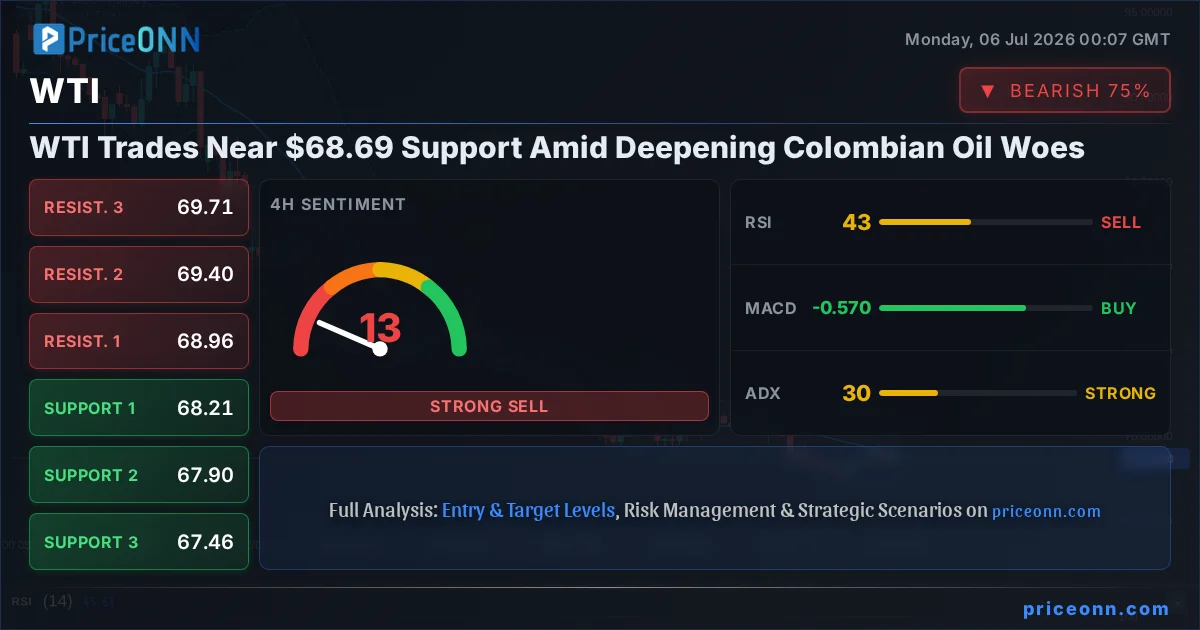
Colombia's vital oil and gas industry is facing a decade-long decline, a situation that is increasingly casting a shadow over global energy markets, particularly for benchmarks like WTI crude. As WTI trades precariously near the $68.69 support level, the deepening woes in Colombia's production landscape serve as a stark reminder of how fundamental supply-side disruptions can influence even established energy benchmarks. This isn't just about one nation's output; it's a signal of broader challenges in maintaining production capacity amidst evolving economic and regulatory pressures, which can ripple through the entire oil complex.
- WTI crude is currently trading around $68.69, testing key support levels.
- Colombia's oil production faces a critical juncture due to shrinking reserves and industry challenges, impacting global supply dynamics.
- The ADX indicator at 17.1 suggests a weak trend, indicating potential for a breakout or further consolidation around current WTI levels.
- Geopolitical factors, such as supply disruptions and policy shifts in major producing regions, are crucial for understanding WTI's price action.
The narrative surrounding Colombia's oil sector is one of persistent struggle. For years, the country has grappled with declining proven reserves, a situation exacerbated by a complex regulatory environment and a shift in focus towards energy transition initiatives. This has led to a shrinking investment appetite in traditional exploration and production, directly impacting the nation's ability to sustain its historical output levels. Recent reports highlight that Colombia's oil and gas reserves are continuously shrinking, a trend that has been ongoing for a decade. This decline isn't merely a statistical anomaly; it represents a fundamental challenge to the country's economic stability and its role as a significant oil producer in the Americas. The implications are far-reaching, potentially affecting regional supply balances and adding a layer of fundamental support or pressure to global oil prices.
This structural issue in Colombia's energy sector comes at a time when global oil markets are already navigating a complex geopolitical landscape. While WTI is currently testing support around $68.69, the broader market sentiment is influenced by a myriad of factors, including OPEC+ production adjustments, demand forecasts, and ongoing geopolitical tensions in key supply regions. The International Energy Agency (IEA) and OPEC regularly provide outlooks that shape market expectations, but the underlying reality of declining production capacity in historically stable regions like Colombia adds an unpredictable element. The fact that WTI is holding near $68.69 suggests a degree of resilience, but the persistent supply-side concerns originating from countries like Colombia cannot be ignored by market participants.
Navigating Weak Trends: What the Indicators Tell Us
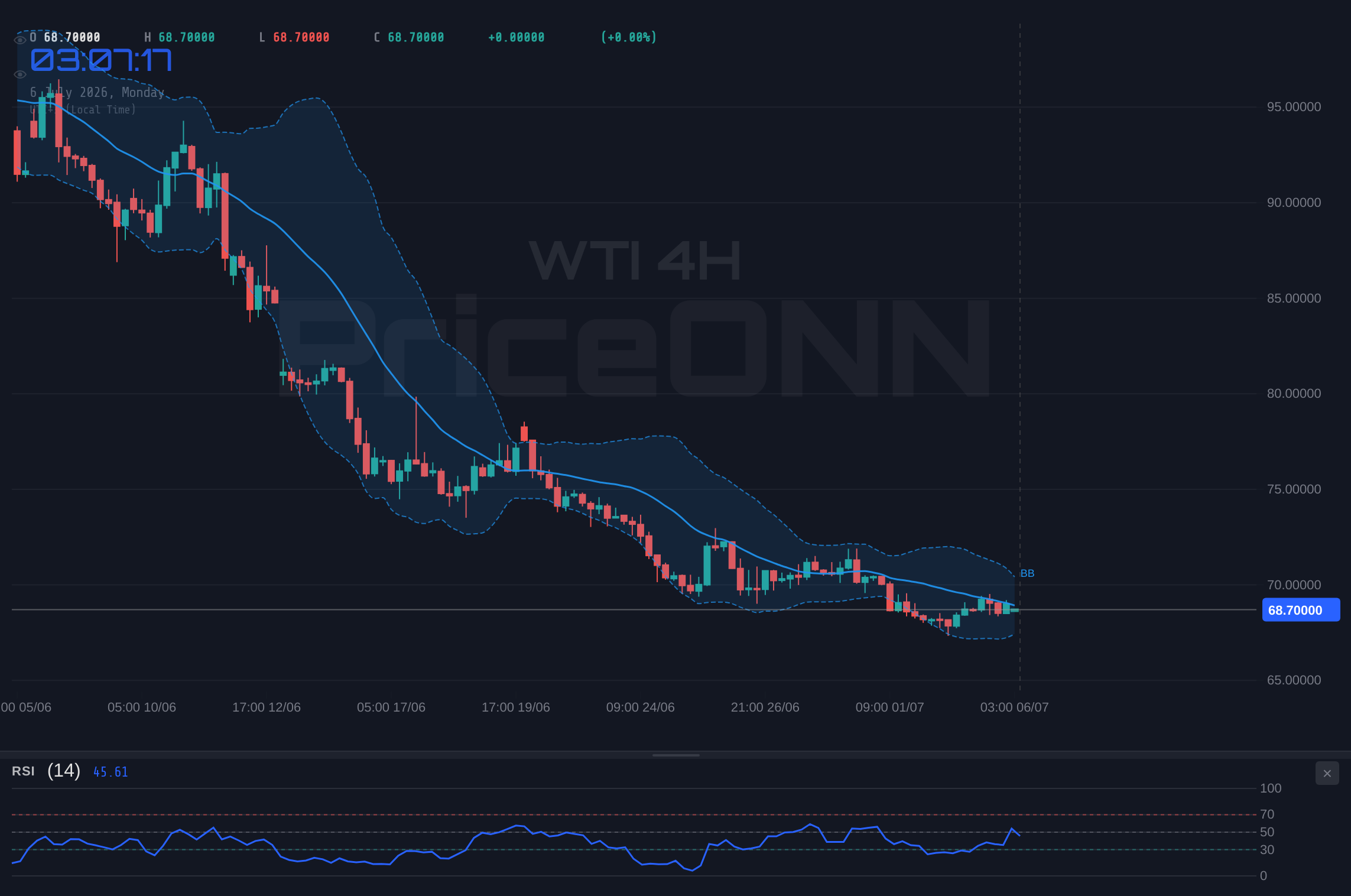
From a technical standpoint, WTI's current positioning around $68.69 presents an interesting case study. On the 1-hour timeframe, the ADX is reading 17.1, indicating a weak trend. This suggests that the market lacks strong directional conviction, and price action could be characterized by choppiness or a potential for a breakout in either direction. While the overall signal for WTI on this timeframe leans towards selling (1 sat, 7 al), the weak trend suggests caution. Traders often look for confirmation from other indicators. For instance, the RSI(14) at 47.7 is in neutral territory but trending downwards, hinting at a slight bearish bias. However, the Stochastic oscillator shows K=48.63 and D=50.06, with %K below %D, suggesting a potential bearish signal, but given the weak trend, it might just be noise within a broader consolidation.
The 4-hour chart offers a slightly different perspective, though still within a range-bound environment. The ADX here is 30.36, which is on the cusp of indicating a stronger trend, but still within the moderate range. The RSI(14) at 42.31 is also in neutral territory and trending downwards, reinforcing the bearish lean seen on the 1-hour chart. The Stochastic indicator, however, shows K=64.69 and D=63.52, with %K above %D, providing a conflicting bullish signal from the oversold region. This divergence in signals across timeframes and indicators is typical of markets in consolidation or transition. The current price of $68.69 is a critical juncture; a failure to hold this level could invite further selling pressure, while a bounce here might be met with resistance as the market digests broader supply-side narratives.
On the daily timeframe, the picture for WTI becomes more bearish, with the ADX at 38.84 indicating a strong downtrend. The RSI(14) is deeply in oversold territory at 27.4, suggesting that while the downtrend is strong, a short-term bounce or reversal could be on the cards. The Stochastic is also deeply oversold, with K=10.52 and D=12.41. This confluence of oversold indicators on the daily chart, against a backdrop of a strong downtrend and the fundamental issues in Colombia, creates a complex trading environment. The price of $68.69 is currently above the daily support level of $67.68, but breaking below it could accelerate the downtrend. The struggle to establish a clear direction highlights the market's indecision, caught between the bearish technical signals on longer timeframes and potential supply-side catalysts.
Geopolitical Currents and Supply Chain Ripples
Beyond the specific issues in Colombia, the global oil market is constantly shaped by geopolitical events. Recent news indicates that OPEC's oil production rebounded sharply in June as Gulf producers brought shut-in barrels back online, potentially easing some supply concerns. However, this rebound might be offset by other factors. For instance, the ongoing concerns about Middle East oil supply, despite operational rebounds in some areas, continue to underpin crude prices. The Straits of Hormuz, a critical chokepoint for oil transport, remains a focal point of geopolitical risk. While recent analysis suggests copper's next move might depend more on Washington than the Strait of Hormuz, the underlying tension in the region undeniably influences oil market sentiment.
Furthermore, the energy transition narrative is playing an increasingly significant role. Reports suggest that Asia is betting on biofuels to dodge Middle East oil shortages, indicating a diversification strategy driven by supply security concerns. Simultaneously, in the United States, courts and Congress are actively challenging policies that could hinder wind power development, signaling a complex interplay between traditional energy sources and renewables. These broader shifts in energy policy and investment can indirectly impact crude oil demand and pricing by altering the long-term energy mix and influencing capital allocation within the energy sector.
The correlation between crude oil prices and the US Dollar Index (DXY) remains a key factor for traders. With the DXY currently trading around 100.89, a level that suggests a strengthening dollar, it typically exerts downward pressure on dollar-denominated commodities like WTI. If the DXY continues its upward trajectory, it could add further headwinds for oil prices, especially if accompanied by rising Treasury yields. Conversely, any signs of weakness in the dollar or a shift in Federal Reserve policy expectations could provide a tailwind for WTI, potentially helping it to reclaim higher ground above $68.69.
The Colombian Conundrum: A Deeper Dive
Colombia's reliance on oil exports makes its declining production capacity a significant concern. The country's oil and gas reserves have been shrinking for a decade, a trend that is difficult to reverse without substantial new discoveries or a major shift in investment policies. The government's focus on energy transition, while globally relevant, has created uncertainty for the traditional oil sector, potentially deterring the long-term investments needed to maintain or increase production. This creates a structural deficit in supply that cannot be easily filled by other producers, especially if they are also facing their own production challenges or adhering to OPEC+ quotas.
The economic implications for Colombia are profound. Oil exports have historically been a major source of foreign exchange and government revenue. A sustained decline in production not only impacts the national budget but also affects employment and related industries. This economic pressure could, in turn, lead to policy adjustments, though the path forward remains uncertain. For the global oil market, Colombia's situation serves as a microcosm of the challenges faced by many oil-producing nations: balancing energy security, economic needs, and the global push towards decarbonization. The price of WTI, currently hovering around $68.69, reflects a market trying to price in these complex, often conflicting, fundamental forces.
Looking Ahead: What to Watch
The immediate future for WTI will likely be dictated by a combination of technical levels and evolving fundamental narratives. The support at $68.69 is a critical line in the sand. A decisive break below this level, especially on increased volume, could signal a further move towards the next support at $67.68. Conversely, if WTI can hold this level and begin to consolidate or move higher, traders will be looking for confirmation from stronger upward momentum, potentially signaled by an improvement in the ADX and a shift in RSI and Stochastic readings. The upcoming economic calendar will also play a crucial role. Key inflation data, employment reports, and central bank policy statements, particularly from the Federal Reserve, will influence both the dollar's strength and risk appetite, thereby impacting crude oil prices.
The ongoing developments in Colombia, coupled with any shifts in OPEC+ strategy or major geopolitical events, will continue to be closely monitored. The market's reaction to the rebound in Gulf production versus the structural decline in other regions will be key. Traders are advised to watch for confluence between technical signals and fundamental catalysts. For example, a bullish technical setup would gain more credibility if accompanied by news of unexpected supply disruptions or stronger-than-anticipated global demand. The current weak trend indicated by the ADX suggests that volatility might increase as the market seeks direction, making disciplined risk management paramount. The $68.69 price point is more than just a number; it represents a battleground between bullish supply-side narratives and bearish technical trends.
Bearish Scenario: Testing Lower Ground
65% ProbabilityBullish Scenario: Bounce from Support
25% ProbabilityNeutral Scenario: Range-Bound Consolidation
10% ProbabilityFrequently Asked Questions: WTI Analysis
What happens if WTI breaks below the $68.69 support level?
A break below $68.69 could trigger further selling, with the next key support level at $67.68. The strong downtrend on the daily chart, indicated by ADX at 38.84, suggests this is a plausible scenario if momentum builds.
Should I buy WTI at current levels of $68.69 given the oversold daily RSI?
While the daily RSI at 27.4 is oversold, suggesting a potential bounce, the weak trend on the 1-hour chart (ADX 17.1) and strong downtrend on the daily (ADX 38.84) warrant caution. A buy signal would be stronger if price holds $68.69 and reclaims $69.44 resistance.
Is the RSI at 27.4 a sell signal for WTI right now?
An RSI reading of 27.4 is considered oversold, typically signaling potential buying opportunities rather than a sell signal. However, in a strong downtrend, oversold conditions can persist. Confirmation from other indicators and price action is crucial.
How will Colombia's oil production issues affect WTI prices this week?
Colombia's shrinking reserves and production challenges create a fundamental supply-side concern. If these issues intensify or lead to further output cuts, it could provide underlying support for WTI, potentially helping it hold the $68.69 level, especially if other supply sources remain constrained.
Track markets in real-time
AI-powered analysis, technical indicators and real-time price data.
Join Our Telegram Channel
Breaking market news, AI analysis and trading signals instantly.
Join Channel