

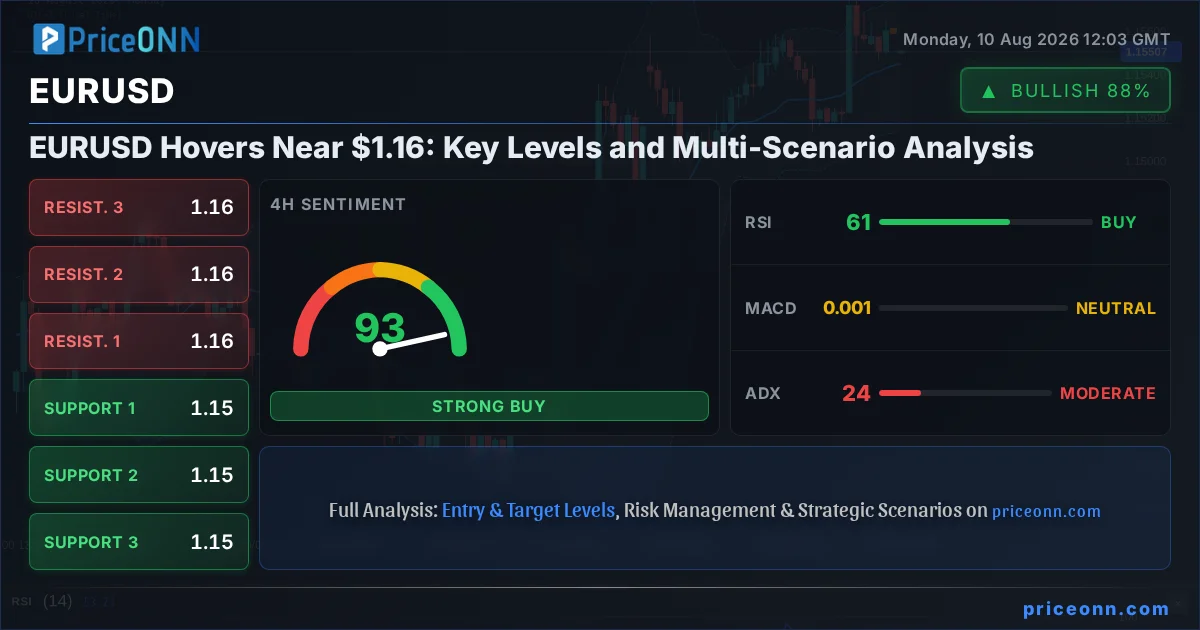
EURUSD is currently navigating a critical juncture, trading around the $1.16 mark. This pivotal level has become a focal point for traders and analysts alike, as the pair consolidates following recent volatility. The current technical landscape presents a complex picture, with conflicting signals across various timeframes and indicators, suggesting a period of indecision that could precede a significant directional move. Understanding the potential pathways forward requires a deep dive into the data, examining not just the immediate price action but also the underlying correlations with broader market forces like the US Dollar Index (DXY), equity market sentiment, and oil price dynamics. As we dissect the current market conditions, we aim to provide a clear roadmap for navigating the upcoming trading sessions, offering insights for scalpers, swing traders, and long-term investors.
- EURUSD RSI at 60.91 signals a neutral-to-bullish leaning, but Stochastic's overbought condition at 87.13/87.53 warrants caution.
- Critical support for EURUSD sits at $1.15225, a level tested multiple times, while resistance looms at $1.15854.
- The MACD on the daily chart shows positive momentum, but the ADX at 26.98 indicates a moderate trend strength, suggesting potential for range-bound trading.
- USDJPY strength and DXY's upward movement near 99.75 are creating headwinds for EURUSD, despite positive Eurozone sentiment data.
The Tug-of-War at $1.16: Decoding EURUSD's Current Stance
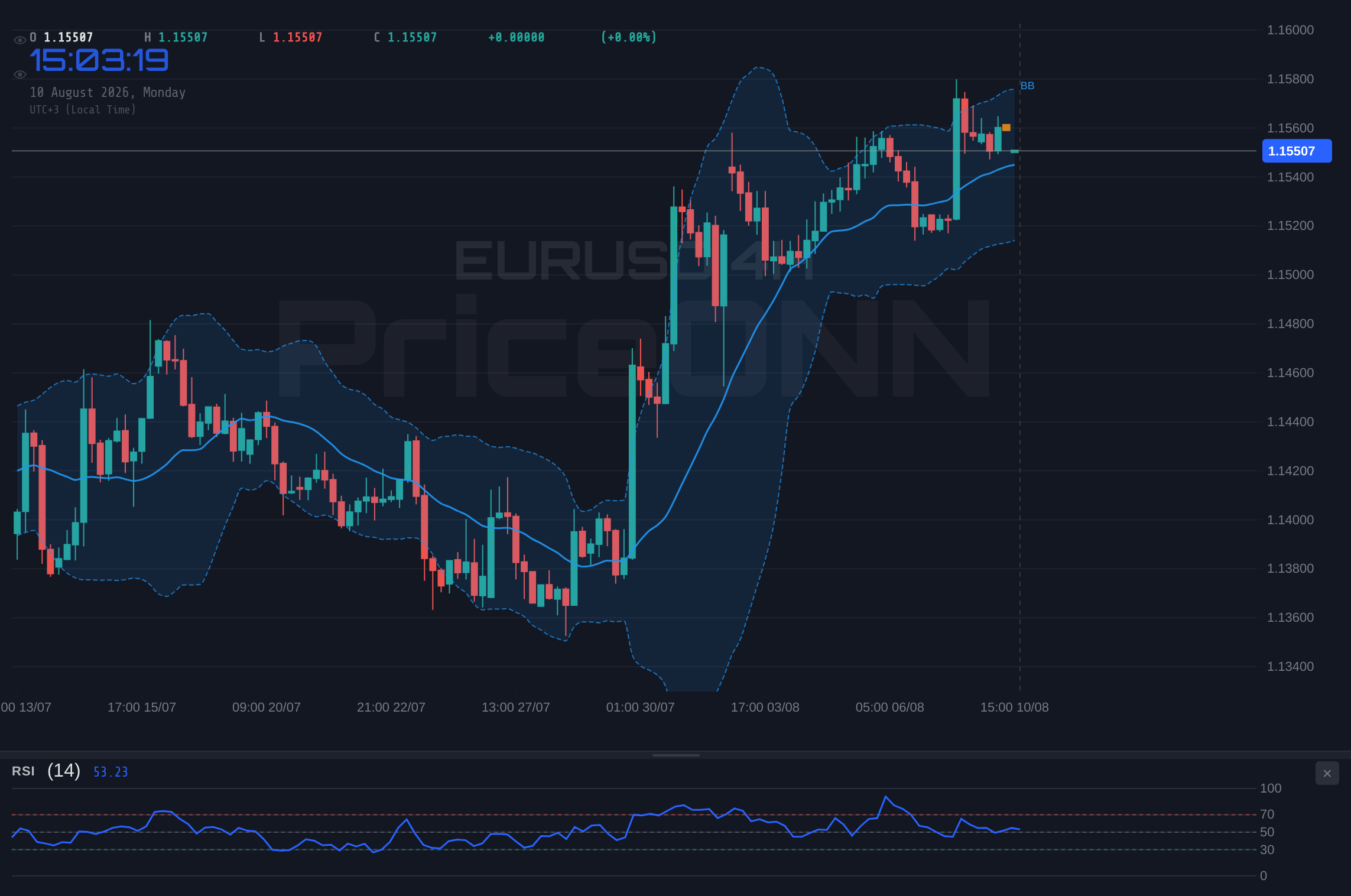
The EURUSD currency pair is currently exhibiting a cautious trading range around the $1.16 handle, a level that has historically acted as a significant psychological and technical pivot. This consolidation phase is characterized by a delicate balance between opposing market forces. On one hand, a generally positive sentiment emanating from the Eurozone, as indicated by improving Sentix confidence, suggests underlying strength for the Euro. However, this is being counteracted by the persistent strength of the US Dollar, fueled by a hawkish undertone from the Federal Reserve and a general flight to safety amid lingering global economic uncertainties. The 1.15516 price point, where EURUSD is currently trading, is a critical area to watch. A decisive break above or below this level could signal the initiation of a new trend, while failure to do so might prolong the current period of range-bound trading.
The interplay between these factors creates a challenging environment for traders. While the daily chart shows positive MACD momentum and RSI hovering in the mid-60s, suggesting a bullish inclination, the Stochastic Oscillator is flashing overbought signals on the daily timeframe (K=86.15, D=87.53), hinting at potential pullbacks. The ADX indicator, at 26.98 on the daily chart, points to a moderately strong trend, but not one that suggests an immediate, explosive breakout. This divergence in signals underscores the indecision in the market and highlights the importance of closely monitoring key support and resistance levels. For scalpers, short-term fluctuations around the $1.1550-$1.1565 range will be crucial, while swing traders will be looking for clear breakouts or breakdowns to initiate positions.
Navigating the Bull's Path: Scenarios for Upside Momentum
For the bulls to regain firm control of the EURUSD pair, several conditions need to align. The immediate bullish scenario hinges on the pair decisively breaking through the resistance cluster situated around the $1.15854 to $1.16141 range. A sustained move and a daily close above $1.16141 would be a strong signal, potentially triggering further upside momentum. This breakout would likely be supported by a weakening US Dollar Index (DXY), perhaps falling back towards the 99.50 level or even lower, and a positive shift in global risk sentiment, potentially reflected in a rally across major equity indices like the S&P 500. On the technical front, such a move would require the RSI to maintain its upward trajectory, ideally staying below the extreme overbought territory (above 70) to allow for further expansion, and the MACD to continue printing positive momentum.
Historically, when EURUSD has managed to break decisively above key resistance levels following a period of consolidation, it has often been driven by shifts in central bank expectations or significant economic data surprises. For instance, a surprisingly dovish tone from the Federal Reserve, or conversely, a hawkish surprise from the European Central Bank (ECB), could provide the necessary catalyst. The ADX at 26.98 suggests that if a breakout occurs, the trend could gain strength rapidly, potentially pushing EURUSD towards the next significant resistance at $1.16483 and beyond. Long-term investors might see such a breakout as a confirmation of a broader bullish reversal, while swing traders would look to enter on the retest of the broken resistance level, now acting as support. Scalpers would focus on capturing quick profits within the intraday trend that emerges from such a breakout.
The Bear's Playbook: Scenarios for Downside Pressure
Conversely, the bearish scenario for EURUSD involves a breakdown below the critical support level. The immediate downside target lies at the first support at $1.15225. A decisive break and a daily close below this level would invalidate the current neutral-to-bullish bias and likely signal a further move towards the next support at $1.14883. This downside move would be exacerbated by a strengthening US Dollar, with the DXY potentially pushing towards the 100.00 psychological level or higher, and a risk-off sentiment gripping global markets. Such a scenario could be triggered by disappointing economic data from the Eurozone, such as weaker-than-expected inflation figures or a significant drop in manufacturing PMIs, or conversely, stronger-than-expected US employment or inflation data that reignites Fed rate hike expectations.
Technically, a breakdown would be confirmed by the RSI falling decisively below 50, and the MACD histogram potentially turning negative or showing increased bearish momentum. The Stochastic Oscillator, already in overbought territory on some timeframes, could then cross bearishly, reinforcing the downward pressure. Historically, periods of sustained dollar strength have often coincided with significant pullbacks in EURUSD, especially when global liquidity tightens or geopolitical tensions escalate. For traders, a breakdown below $1.15225 presents a clear opportunity for short positions, targeting the subsequent support levels. Swing traders might enter on the retest of $1.15225 as resistance, while scalpers would aim to capture the immediate downside move. Long-term investors would assess whether this breakdown signals a return to a broader bearish trend for the pair.
The Waiting Game: Neutral Scenario and Consolidation Factors
The neutral scenario posits that EURUSD will remain range-bound, trading between the key support and resistance levels identified. This scenario is plausible given the current mixed signals and the ADX readings suggesting moderate trend strength rather than a dominant trend. Factors that could keep the pair locked in a range include a balanced flow of economic data from both the US and the Eurozone, where positive news from one region is offset by negative news from the other. For example, strong US employment figures might be countered by weak Eurozone inflation, leading to a stalemate.
Geopolitical stability, or rather the absence of major escalations, can also contribute to a neutral outlook. If no significant geopolitical events emerge to drastically alter risk appetite, and central banks maintain a steady communication approach, EURUSD could continue to oscillate. Technologically, this range-bound environment would be characterized by RSI readings fluctuating around the 50-60 level, MACD showing choppy momentum, and Stochastic oscillators frequently moving in and out of overbought/oversold zones without establishing a clear direction. Bollinger Bands might hug the middle band, indicating a lack of strong directional impulse. In such a scenario, traders would focus on range-bound strategies, buying near support and selling near resistance, while remaining vigilant for any signs of a breakout that would signal the end of the consolidation phase. This 'waiting game' can be profitable for nimble traders but requires patience and strict risk management.
Correlation Analysis: EURUSD's Dance with Global Markets
Understanding EURUSD's movements requires a keen eye on its correlations with other major financial instruments. The US Dollar Index (DXY) remains a primary driver. Currently, the DXY is trading around 99.75, showing upward momentum. A strengthening DXY typically exerts downward pressure on EURUSD, as it signifies a stronger US dollar relative to a basket of other major currencies. This inverse relationship is a cornerstone of forex analysis. When the DXY is rising, as it is now with upward momentum on multiple timeframes, it creates headwinds for EURUSD, making bullish scenarios more challenging unless offset by strong Euro-specific catalysts.
Equity markets, particularly the S&P 500 and Nasdaq, serve as a barometer for risk appetite. The S&P 500 is showing upward movement around 6572.87, while Nasdaq is also higher near 29755.41. Generally, a risk-on environment, where equities rally, can sometimes weaken the US dollar as investors seek higher yields in riskier assets, potentially benefiting EURUSD. Conversely, a risk-off sentiment, marked by falling stock markets, often boosts the dollar as a safe-haven asset, putting pressure on EURUSD. Currently, the mixed signals in equities - S&P 500 showing strength on the 4H but a bearish daily trend - add to the complexity. Oil prices, with Brent at $83.78 and WTI at $80.55, are showing significant upward momentum. Rising oil prices can signal increasing inflation expectations, potentially prompting central banks to adopt a tighter monetary policy, which could strengthen the dollar and thus pressure EURUSD.
The correlation analysis reveals a complex web of influences. While a rising DXY and strong oil prices suggest potential headwinds for EURUSD, the mixed signals from equity markets and the ongoing debate about central bank policy add layers of uncertainty. Traders must consider these interconnected markets to form a comprehensive view. For example, if the DXY continues its ascent towards 100.00, it would likely reinforce the bearish case for EURUSD, especially if accompanied by renewed risk aversion in equities. Conversely, a significant pullback in the DXY below 99.50, coupled with a dovish shift in Fed expectations, could open the door for a bullish reversal in EURUSD, irrespective of oil price movements.
What Different Traders Should Watch
The current market environment around EURUSD at $1.16 presents distinct opportunities and challenges for various trading styles. For scalpers, the focus will be on short-term price action within the established ranges, particularly around the $1.1550-$1.1565 intraday levels. They will be looking for quick entries and exits based on micro-trends and immediate order flow, aiming to capture small gains from minor fluctuations. Key for them is identifying liquidity pockets and avoiding periods of extremely low volume, which can lead to erratic price spikes. The 1-hour chart indicators, such as the Stochastic and RSI, will be closely monitored for short-term overbought/oversold signals within the intraday range.
Swing traders will be more interested in clear directional signals and potential breakouts or breakdowns. They will be watching for a decisive close above $1.15854 (resistance) or below $1.15225 (support) on the 4-hour or daily charts. A confirmed breakout would trigger entry points, with targets set at the next significant support or resistance levels. They will pay close attention to ADX values, looking for readings above 25 to confirm a developing trend. The historical context of how EURUSD behaved at similar levels in the past will also be crucial for their decision-making process. Patience is key for swing traders, as they wait for high-probability setups to materialize.
Long-term investors, on the other hand, will be looking at the bigger picture, focusing on the daily and weekly trends. They will be assessing whether the current price action is part of a larger consolidation within a long-term trend or the beginning of a significant reversal. Fundamental drivers, such as long-term interest rate differentials, central bank policy divergence, and geopolitical stability, will be paramount. They might view the current levels as a potential accumulation zone if they believe the Euro is set for a sustained appreciation against the dollar over the coming months or years. They will be less concerned with short-term volatility and more focused on the macro-economic underpinnings that could drive EURUSD significantly higher or lower over a longer horizon.
Economic Calendar and Geopolitical Undercurrents
The economic calendar remains a critical factor influencing EURUSD. Recent data, such as the surprisingly weak US Non-Farm Payrolls (NFP) report, has already caused significant shifts in market expectations regarding Federal Reserve policy, leading to a weaker dollar and supporting pairs like EURUSD. However, the narrative can quickly change with upcoming data. Investors will be closely watching US inflation data, such as CPI and PCE, as these will be key determinants of the Fed's future rate decisions. Similarly, Eurozone inflation figures and growth indicators (like PMI and Sentix Confidence, which recently showed improvement) will provide crucial insights into the ECB's policy path and the overall health of the Eurozone economy. The interplay between US and EU economic performance, and their respective central bank responses, will continue to dictate the direction of EURUSD.
Geopolitical developments also cast a long shadow over currency markets. Lingering tensions in Eastern Europe, the Middle East, and the ongoing US-China trade relations remain significant risk factors. Any escalation or de-escalation in these areas can trigger shifts in global risk appetite, impacting the US Dollar as a safe-haven asset and consequently influencing EURUSD. For instance, a sudden increase in geopolitical risk could lead to a flight to the dollar, strengthening DXY and pressuring EURUSD lower, even if Eurozone economic data is supportive. Conversely, a period of geopolitical calm could bolster risk sentiment, potentially weakening the dollar and providing a tailwind for EURUSD. The market's reaction to such events is often swift and can override short-to-medium term technical signals, making it essential for traders to stay informed about global news flow.
The Bull's Roadmap: Targeting Higher Levels
Bullish Scenario: Breaking the Chains
35% ProbabilityWhere Bears Take Control: Scenarios for a Downturn
Bearish Scenario: The Dollar's Grip Tightens
55% ProbabilityThe Waiting Game: Consolidation and Range-Bound Play
Neutral Scenario: Stuck in the Middle
10% ProbabilityTechnical Dashboard and Key Levels
| Indicator | Value | Signal | Interpretation |
|---|---|---|---|
| RSI (14) | 60.91 | Neutral | Slightly bullish, but approaching overbought zone |
| MACD | Positive Momentum | Bullish | Above signal line, indicates upward pressure |
| Stochastic | K:86.15, D:87.53 | Bearish | Overbought, potential for pullback |
| ADX | 26.98 | Moderate Trend | Suggests a trend is developing, but not yet strong |
| Bollinger Bands | Above Mid-Band | Bullish | Price trading above the middle band indicates upward bias |
Frequently Asked Questions: EURUSD Analysis
What happens if EURUSD breaks below the $1.15225 support level?
A decisive close below $1.15225 would invalidate the current bullish bias and likely trigger further downside towards $1.14883. This scenario becomes more probable if the DXY strengthens significantly and US economic data continues to surprise to the upside.
Should I consider buying EURUSD at current levels near $1.16 given the mixed signals?
Buying at current levels carries risk due to the overbought Stochastic signals and strong DXY. A more prudent approach would be to wait for a confirmed breakout above $1.15854 with strong volume, or a clear bounce from the $1.15225 support level, indicating better risk-reward.
Is the RSI at 60.91 a sign of strength or a warning for EURUSD?
An RSI of 60.91 is generally considered neutral-to-bullish, indicating upward momentum. However, it's nearing the overbought threshold, and combined with other indicators like the Stochastic, it suggests that further significant gains might be limited without a clear catalyst or consolidation.
How will upcoming US inflation data affect EURUSD this week?
Stronger-than-expected US inflation could fuel Fed rate hike expectations, strengthening the dollar and potentially pushing EURUSD down towards $1.14883. Conversely, cooler inflation might lead to Fed dovishness, weakening the dollar and supporting a move towards $1.15854 or higher.
Track markets in real-time
AI-powered analysis, technical indicators and real-time price data.
Join Our Telegram Channel
Breaking market news, AI analysis and trading signals instantly.
Join Channel