

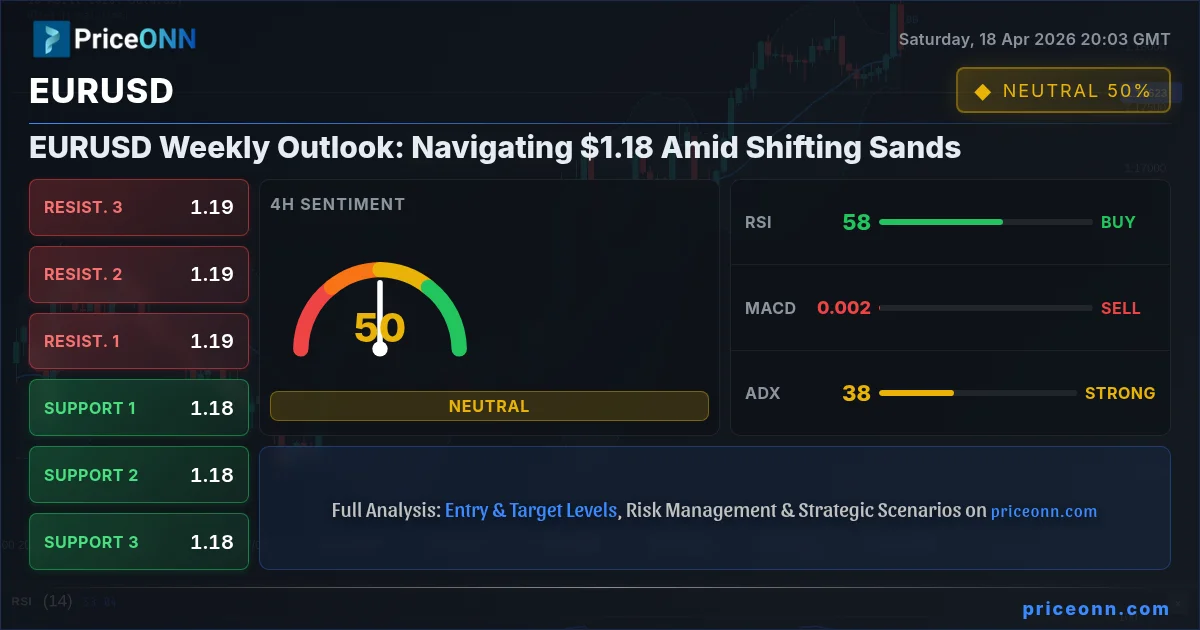
The EURUSD pair concluded the past trading week hovering around the significant $1.18 mark, a level that has acted as a pivot point, reflecting a period of consolidation rather than decisive direction. This past week, characterized by a tug-of-war between a strengthening dollar and underlying euro resilience, saw the pair oscillate within a tight range. Traders are now dissecting the week's price action, looking for clues to decipher the next move amidst a complex interplay of technical signals and looming economic data. The neutral sentiment on the 1-hour chart, contrasted with a more bullish lean on the daily timeframe, highlights the current indecision. This analysis delves into the technical underpinnings, correlative market dynamics, and potential catalysts that will shape EURUSD's trajectory in the coming week, aiming to provide a clear roadmap for navigating these choppy waters.
- EURUSD is currently trading around $1.18, marking a period of consolidation after a volatile week.
- The 1-hour RSI at 38.74 indicates bearish momentum, while the daily RSI at 60.87 suggests underlying bullish potential.
- Key support is holding at $1.17546, with resistance eyed at $1.18115.
- The DXY index's recent dip to 97.9 and its ADX at 37.19 suggest underlying dollar weakness, potentially supporting EURUSD.
- Upcoming U.S. Retail Sales and Eurozone inflation data are critical catalysts for the next directional move.
Navigating the Consolidation Zone: A Technical Crossroads
The technical landscape for EURUSD presents a fascinating dichotomy. On the shorter timeframes, particularly the 1-hour chart, the indicators paint a somewhat cautious picture. The Relative Strength Index (RSI) hovers at 38.74, signaling a bearish momentum that, while not yet in oversold territory, suggests sellers have had the upper hand recently. This is further corroborated by the Moving Average Convergence Divergence (MACD), which shows negative momentum with its signal line firmly above the MACD line, indicating a downward bias. The Stochastic Oscillator, with %K at 8.68 and %D at 37.13, is deeply in oversold territory, flashing a potential reversal signal but also highlighting the intensity of the recent selling pressure. The Average Directional Index (ADX) at 18.06 points to a weak trend, typical of consolidation phases where price action lacks conviction.
However, to dismiss EURUSD based solely on these short-term signals would be premature. The 4-hour chart introduces a more nuanced perspective. Here, the RSI stands at a healthier 58.18, indicating a neutral-to-bullish bias and suggesting that the underlying sentiment might be shifting. While the MACD still shows negative momentum, the Stochastic Oscillator (%K at 60.96, %D at 34.62) provides a clear bullish signal, crossing upwards from oversold levels. The ADX here climbs to 38.1, indicating a strong trend is developing, which, combined with the bullish Stochastic, hints at a potential upward move. This divergence between the 1-hour and 4-hour charts underscores the current indecision in the market, with short-term traders likely on the sidelines awaiting clearer signals.
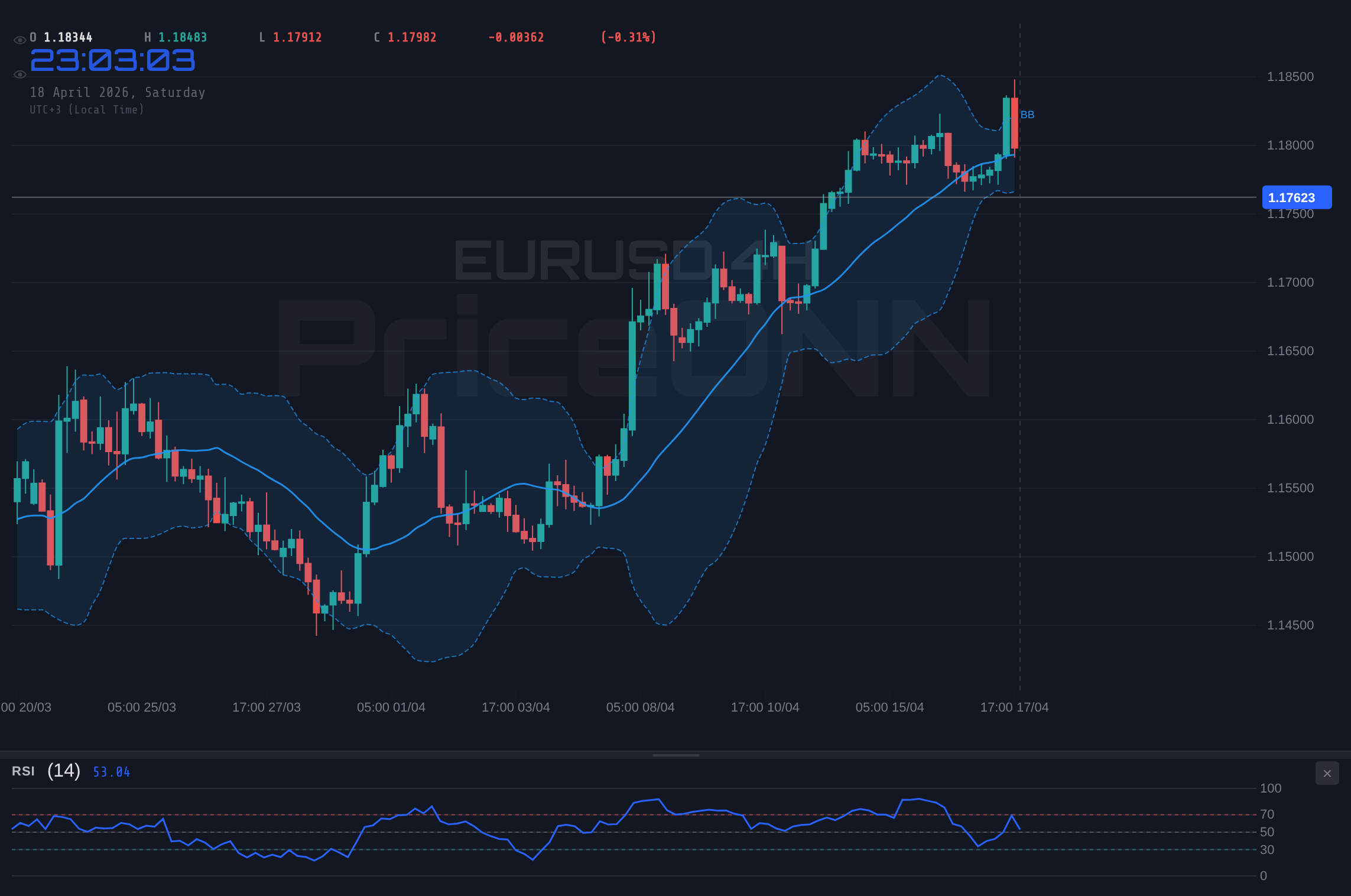
Zooming out to the daily timeframe, the picture brightens considerably for the euro. The RSI sits at a robust 60.87, comfortably in bullish territory and indicating sustained upward pressure. The MACD is exhibiting positive momentum, with the MACD line above its signal line, reinforcing the bullish sentiment. The Stochastic Oscillator, although nearing overbought conditions with %K at 85.04 and %D at 92.18, still shows a strong upward trend. Crucially, the ADX on the daily chart registers 28.38, confirming a strong upward trend. This longer-term bullish bias on the daily chart, despite the short-term headwinds, suggests that any pullbacks might be opportunities for bulls to re-enter the market, provided key support levels hold. The current price of $1.18 sits just below the $1.18115 resistance, making this level a crucial battleground for the upcoming week.
The Bollinger Bands also offer insights. On the 1-hour chart, EURUSD is trading below the middle band, a bearish sign suggesting downward pressure. However, on the 4-hour and daily charts, the pair is trading above the middle band, indicating a bullish inclination. This alignment across multiple timeframes above the middle band, particularly on the daily chart, strengthens the argument for a potential upside continuation. The critical factor will be the pair's ability to sustain its position above the $1.17546 support level. A break below this could invalidate the daily bullish outlook and trigger a sharp move lower, potentially targeting the $1.17320 level.
The overall technical consensus, weighted by timeframe, leans towards a cautiously bullish outlook, particularly on the daily charts. The confluence of a strong daily RSI, positive MACD momentum, and the pair trading above its daily middle Bollinger Band suggests that the medium-term trend remains intact. However, the bearish signals on the 1-hour chart cannot be ignored, especially for intraday traders. The $1.18 level is not just a psychological mark; it's a confluence of recent price action and a key resistance point that needs to be decisively broken for the bullish case to gain significant traction. Until then, expect choppy trading with potential for sharp reversals as short-term sellers attempt to regain control.
The Dollar's Dance: DXY and Risk Sentiment
Understanding the EURUSD's movements requires a keen eye on its primary counterpart: the US Dollar Index (DXY). This past week, the DXY experienced a notable pullback, currently trading at 97.9. While this represents a slight daily decline of -0.06%, the broader context is crucial. The DXY's 4-hour chart shows a strong downtrend with an ADX reading of 37.19, indicating that the dollar's strength has been waning. This weakness is a significant tailwind for EURUSD. The 1-hour RSI for the DXY is at 56.83, showing some upward momentum, but the MACD is in negative territory, and the Stochastic Oscillator is giving a bearish signal (%K
This dollar weakness has been a key driver behind the euro's resilience, particularly on the daily charts where EURUSD shows a bullish bias. When the DXY falls, it typically implies increased demand for other currencies, including the euro, especially when global risk appetite is relatively stable or improving. The current market sentiment appears to be a mixed bag; while the US stock markets like the S&P 500 (trading at 6572.87, up 0.74%) and Nasdaq (trading at 26682.75, up 1.45%) show signs of risk-on behavior, the significant drop in oil prices (Brent at 92.54, down 6.93%) introduces a note of caution. This juxtaposition suggests that while equities might be rallying, underlying inflationary concerns or geopolitical tensions could be capping broader risk appetite, leading to a somewhat contained reaction in forex markets.
The correlation between the DXY and EURUSD is usually inverse, meaning as the dollar strengthens, the euro tends to weaken, and vice-versa. With the DXY showing signs of topping out and potentially heading lower, especially on the longer timeframes, this provides a foundational support for EURUSD. The fact that EURUSD is holding above $1.17546 despite mixed short-term signals can be partly attributed to this dollar softness. However, traders should remain vigilant. Any unexpected shift in risk sentiment, perhaps triggered by geopolitical events or a sudden change in central bank rhetoric, could quickly reverse the DXY's trend and put immediate pressure on the euro.
The interplay between inflation expectations and central bank policy is also a critical factor. The recent drop in oil prices, while seemingly positive for inflation, could also signal concerns about global demand, adding another layer of complexity. If inflation fears subside significantly, it might lead central banks, particularly the Fed, to adopt a less hawkish stance, further weakening the dollar. Conversely, if inflation proves stubborn, the pressure will remain on central banks to maintain tighter monetary policies, which could eventually support the dollar. For EURUSD, this translates to a delicate balancing act: the euro benefits from dollar weakness, but persistent global growth concerns could cap its upside potential.
The upcoming economic calendar is packed with high-impact events that are likely to dictate the next significant move for both the DXY and EURUSD. U.S. Retail Sales data, due this week, will be a crucial gauge of consumer resilience amid rising inflation. Stronger-than-expected sales could bolster the dollar, while a disappointing report might accelerate its decline. On the Eurozone side, inflation figures will be closely watched. If inflation comes in higher than the forecast of 2.5%, it could embolden the ECB to signal a more hawkish policy path, providing a significant boost to the euro. The current technical setup, with EURUSD poised at a critical juncture and the DXY showing weakness, suggests that these economic releases will be the primary catalysts for breaking the current consolidation.
Key Levels and Trade Scenarios: Charting the Path Forward
As we look ahead, the $1.18 level remains the focal point for EURUSD. On the weekly chart, the pair has shown resilience, but breaking above the $1.18115 resistance is paramount for initiating a sustained upward move. The first significant resistance target lies at $1.18458, followed by $1.18684. A decisive break above these levels, especially on strong volume and positive economic news, could signal the start of a more significant rally. The bullish case is underpinned by the daily chart's technicals and the broader dollar weakness observed across multiple timeframes.
Conversely, the support levels are critical for maintaining the bullish bias. The immediate support is situated at $1.17546. A failure to hold this level would be a significant bearish signal, potentially opening the door for a sell-off towards the next support at $1.17320. Should this level also give way, the bears could gain control, targeting the $1.16977 support. The short-term bearish momentum indicated by the 1-hour RSI and MACD suggests that a test of these lower levels is a plausible scenario, especially if upcoming economic data disappoints or geopolitical tensions escalate.
The ADX readings across different timeframes present an interesting dynamic. The strong ADX on the 4-hour (38.1) and daily (28.38) charts suggests that a trend is likely to emerge, whether bullish or bearish. The weak ADX on the 1-hour (18.06) chart indicates that intraday trading might remain range-bound or prone to false breakouts. Therefore, for a clear directional trade, focusing on the daily and 4-hour trends and waiting for confirmation after major economic events will be key. The Stochastic Oscillator's extreme readings also suggest that the market is ripe for a significant move, but timing the entry will be crucial to avoid being caught in a whipsaw.
Considering the current technical setup and the looming economic events, a balanced approach is warranted. While the daily chart leans bullish, the short-term bearish signals and the critical $1.18 resistance cannot be overlooked. The probability of a breakout above $1.18115 hinges heavily on positive Eurozone data and continued dollar weakness. Conversely, a weaker-than-expected Eurozone inflation report or a sudden dollar rebound could see EURUSD retreating towards its support levels. The $1.17546 level is therefore the line in the sand that traders will be watching closely.
Bearish Scenario: Retreat Below $1.18
35% ProbabilityNeutral Scenario: Consolidation Around $1.18
30% ProbabilityBullish Scenario: Breakout Above Resistance
35% ProbabilityEconomic Catalysts on the Horizon
The market's current state of flux means that upcoming economic data releases will carry significant weight. For the US Dollar, all eyes will be on the U.S. Retail Sales figures. The previous report showed a contraction of -0.913%, far below the forecast of 2.1%, indicating potential weakness in consumer spending. While the forecast for the upcoming release is 2.6%, any deviation from this expectation could trigger substantial volatility in the DXY and, consequently, in EURUSD. A surprisingly strong reading might reignite dollar strength, pushing EURUSD lower, while a miss could accelerate the dollar's downtrend, supporting a move above $1.18.
On the Eurozone side, inflation data is the key event. The previous inflation figure was 1.9%, and the forecast is for a rise to 2.5%. This anticipated increase is significant, as it could signal mounting price pressures within the bloc. If actual inflation figures come in at or above 2.5%, it might lead the European Central Bank (ECB) to adopt a more hawkish tone in its future communications, potentially boosting the euro. Conversely, if inflation falters, it could reinforce expectations of continued accommodative policy from the ECB, capping any significant upside for EURUSD. The previous month's inflation reading of 1.9% was already a concern, so this upcoming print is critical.
Other data points, such as the U.S. Consumer Price Index (CPI) and Non-Farm Payrolls (NFP), although not explicitly detailed in the provided economic calendar summary for the immediate next 7 days, remain background noise that could influence market sentiment. Historically, these releases have been major market movers. Traders will be closely monitoring any central bank speeches or policy meeting minutes that emerge, as these can provide forward guidance on monetary policy expectations. The current environment, where markets are sensitive to inflation and interest rate differentials, means that even minor shifts in central bank rhetoric can have a disproportionate impact on currency pairs like EURUSD.
The interplay between these data points and the existing technical picture creates a high-stakes environment. The resistance at $1.18115 and support at $1.17546 are the immediate levels to watch. A breakout above resistance, fueled by positive Eurozone data and continued dollar weakness, could target $1.18458 and beyond. However, a failure to break higher, coupled with disappointing Eurozone inflation or strong US retail sales, could see a swift move back towards $1.17546 and potentially lower. The ADX at 28.38 on the daily suggests a trend is likely to take hold post-data release, making the direction of the breakout crucial.
Given the conflicting signals across different timeframes and the significant economic events on the horizon, patience will be a virtue for traders. The market appears to be waiting for a catalyst to break the current consolidation. The $1.18 level represents a critical juncture, and the direction it ultimately breaks will likely set the tone for the subsequent trading sessions. Risk management remains paramount, especially when trading around major data releases. Understanding the potential impact of both dollar dynamics and Eurozone inflation data will be key to navigating this period effectively.
The Bigger Picture: Global Risk and Intermarket Correlations
Beyond the immediate technicals and economic data, the broader market context provides essential insights into EURUSD's potential path. The significant drop in Brent crude oil prices to $92.54, down nearly 7% for the week, signals potential concerns about global demand or a de-escalation of geopolitical tensions in key regions like the Strait of Hormuz. While lower oil prices can be deflationary, easing inflation concerns for central banks, a sharp decline can also be interpreted as a sign of economic slowdown, which typically dampens risk appetite. This can lead to a 'risk-off' environment where investors flock to safe-haven assets, potentially strengthening the dollar despite its current weakness, and capping the euro's gains.
The performance of major equity indices like the S&P 500 and Nasdaq Composite, both showing strong upward momentum this week, suggests a prevailing 'risk-on' sentiment in certain market segments. The S&P 500 is up 0.74% at 6572.87, and the Nasdaq has gained 1.45% to 26682.75. This suggests that investors are still willing to take on risk, which typically supports riskier currencies like the euro against traditional safe havens. However, the sharp decline in oil prices introduces a conflicting signal. If the equity rally is built on shaky foundations or if the oil price drop is a precursor to broader economic concerns, the 'risk-on' sentiment could quickly evaporate, leading to a reversal in currency markets.
The correlation between EURUSD and the US Dollar Index (DXY) remains a primary focus. With the DXY currently trading at 97.9 and showing signs of a potential downtrend on daily charts (RSI 40.62, ADX 26.2), this provides a supportive backdrop for EURUSD. A sustained break below the DXY's support levels could unlock further upside potential for the euro. However, traders must be mindful of the potential for sharp reversals. If geopolitical tensions were to flare up unexpectedly, or if US economic data were to significantly outperform expectations, the dollar could quickly regain its strength, reversing the recent trend and putting pressure on EURUSD.
The cryptocurrency market, particularly Bitcoin (BTCUSD at 75658, down 2.18%) and Ethereum (ETHUSD at 2346.94, down 3.18%), also offers clues about risk sentiment. The recent downturn in crypto prices, despite some short-term technical signals suggesting potential rebounds, indicates a cautious approach from investors in this highly speculative asset class. This could be interpreted as a sign that broader risk appetite is not as robust as equity markets might suggest. If crypto continues to underperform, it could spill over into other risk-sensitive currency pairs, potentially hindering EURUSD's ability to climb higher even if the dollar weakens.
The macro environment for EURUSD is complex. Bullish factors include dollar weakness and a generally positive, albeit cautious, risk sentiment reflected in equities. However, headwinds exist in the form of falling oil prices, which could signal demand concerns, and the potential for renewed geopolitical flare-ups. The upcoming economic data releases from both the US and the Eurozone will be critical in determining whether the current consolidation breaks to the upside or downside. For now, the $1.18 level remains the key battleground, with the interplay of dollar dynamics, inflation expectations, and risk sentiment shaping the narrative.
Frequently Asked Questions: EURUSD Analysis
What happens if EURUSD breaks below the $1.17546 support level this week?
A break below $1.17546 would invalidate the daily bullish bias and could trigger a move towards $1.17320. This scenario is more likely if upcoming US Retail Sales data surprises to the downside or if Eurozone inflation disappoints, leading to renewed dollar strength.
Should I trade EURUSD at current levels around $1.18 given the mixed technical signals?
Given the consolidation around $1.18 and conflicting signals between short-term and long-term charts, caution is advised. A high-probability setup would involve waiting for a decisive break above $1.18115 resistance or a confirmed hold of $1.17546 support, ideally confirmed by upcoming economic data.
Is the RSI at 60.87 on the daily chart a strong buy signal for EURUSD?
An RSI of 60.87 on the daily chart indicates a bullish trend but is not yet in extreme overbought territory. It suggests underlying strength but also warrants watching for potential pullbacks towards the $1.17546 support level before considering a long position.
How will the upcoming U.S. Retail Sales data potentially impact EURUSD near $1.18?
A surprisingly strong US Retail Sales figure could boost the dollar, pushing EURUSD below $1.18 towards $1.17546. Conversely, a weaker-than-expected report might accelerate dollar weakness, potentially aiding EURUSD's break above the $1.18115 resistance level.
The past week has been a period of watchful waiting for EURUSD traders, with the pair consolidating around the pivotal $1.18 level. While short-term technical indicators flash cautionary signals, the longer-term daily charts maintain a bullish undertone, supported by a weakening US Dollar Index. The upcoming economic data from both sides of the Atlantic, particularly U.S. Retail Sales and Eurozone inflation, are poised to be the key catalysts that break this stalemate. Navigating these potentially volatile events requires a disciplined approach, focusing on key support at $1.17546 and resistance at $1.18115. Patience and adherence to risk management principles will be crucial as the market seeks direction in the week ahead.
| Indicator | Value | Signal | Interpretation |
|---|---|---|---|
| RSI (14) | 38.74 | Bearish | 1H: Bearish momentum |
| MACD | Neg Momentum | Bearish | 1H: Negative momentum |
| Stochastic | K=8.68, D=37.13 | Bearish | 1H: Deeply oversold, potential reversal |
| ADX | 18.06 | Weak | 1H: Weak trend, consolidation |
| RSI (14) | 60.87 | Bullish | 1D: Bullish territory |
| MACD | Pos Momentum | Bullish | 1D: Positive momentum |
| Stochastic | K=85.04, D=92.18 | Bearish | 1D: Approaching overbought |
| ADX | 28.38 | Bullish | 1D: Strong uptrend |
Track markets in real-time
AI-powered analysis, technical indicators and real-time price data.
Join Our Telegram Channel
Breaking market news, AI analysis and trading signals instantly.
Join Channel