

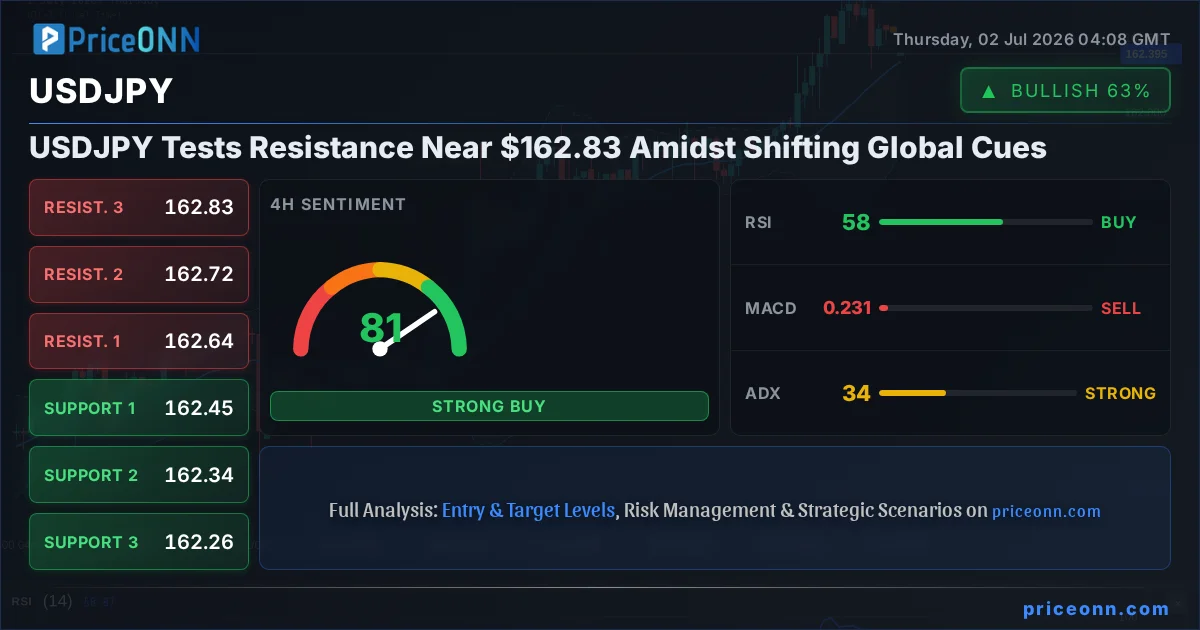
The forex market is a complex tapestry, and right now, the USDJPY pair is weaving a narrative of cautious ascent. As traders eye the resistance around $162.83, the underlying currents suggest a battleground where bullish momentum meets potential headwinds. This isn't just about a single currency pair; it's a reflection of broader economic forces, central bank policies, and shifting global risk appetite, all of which are painting a nuanced picture for the yen and the dollar.
- USDJPY is testing resistance near $162.83, a critical level for the pair's immediate direction.
- The 4-hour chart shows a strong uptrend (ADX 33.99), but the daily timeframe presents a bearish signal with RSI at 75.19.
- The US Dollar Index (DXY) is currently at 101.38, showing a neutral trend but with a strong daily uptrend signal, influencing USDJPY.
- Traders should closely watch upcoming US Non-Farm Payrolls data for potential volatility and direction.
The recent price action for USDJPY, currently trading at $162.45, highlights a significant technical juncture. On the 4-hour chart, the trend is decidedly bullish with a strong ADX reading of 33.99, indicating robust momentum. This suggests that the bulls have been in control, pushing the pair upwards. However, a deeper dive into the daily timeframe reveals a different story. The RSI(14) at 75.19 screams 'overbought,' a classic warning sign that the current rally might be nearing exhaustion and could be due for a correction. This divergence between short-term bullish strength and long-term overbought conditions creates a fascinating dynamic, one that requires careful navigation.
This technical tug-of-war is amplified by the interplay with the US Dollar Index (DXY). Currently hovering around 101.38, the DXY presents a mixed picture across different timeframes. While its 1-hour and 4-hour trends are neutral, the daily chart shows a strong uptrend signal. This suggests that, broadly speaking, the dollar has underlying strength, which typically supports USDJPY. However, the neutral short-term trend for the DXY implies that dollar bulls might be pausing for breath, or perhaps waiting for fresh catalysts. Any significant move in the DXY, whether up or down, will undoubtedly have a ripple effect on USDJPY, potentially exacerbating the existing tension or providing the clarity traders are seeking.
The recent news flow, particularly concerning upcoming US macroeconomic data, adds another layer of complexity. The Non-Farm Payrolls (NFP) report, due imminently, is a critical event on the economic calendar. Historically, strong NFP figures can bolster the dollar by reinforcing expectations of a hawkish Federal Reserve stance, potentially pushing USDJPY higher. Conversely, weaker-than-expected data could trigger dollar weakness and a USDJPY pullback. Traders are keenly aware of this, and the market may be exhibiting a 'wait-and-see' attitude as it braces for the impact of this pivotal report. The anticipation alone can lead to choppy price action and increased volatility.
Navigating the Technical Landscape: A Multi-Timeframe Perspective
Delving deeper into the technicals, the USDJPY's 1-hour chart paints a picture of immediate bullishness. The trend is neutral but with a strong overall signal leaning towards 'buy' (Al: 8, Sat: 0, Nötr: 0). The RSI(14) is at 42.08, indicating room for upward movement before hitting overbought territory, while the MACD shows negative momentum, suggesting that the recent upward push might be losing steam on this very short-term view. However, the Stochastic oscillator, with %K at 34.41 and %D at 61.6, is flashing a bearish signal, indicating that the pair might be heading lower in the immediate hours. The ADX at 21.02 points to a moderate downtrend on this timeframe, which contradicts the overall 'buy' signal, creating a lack of confluence that demands caution.
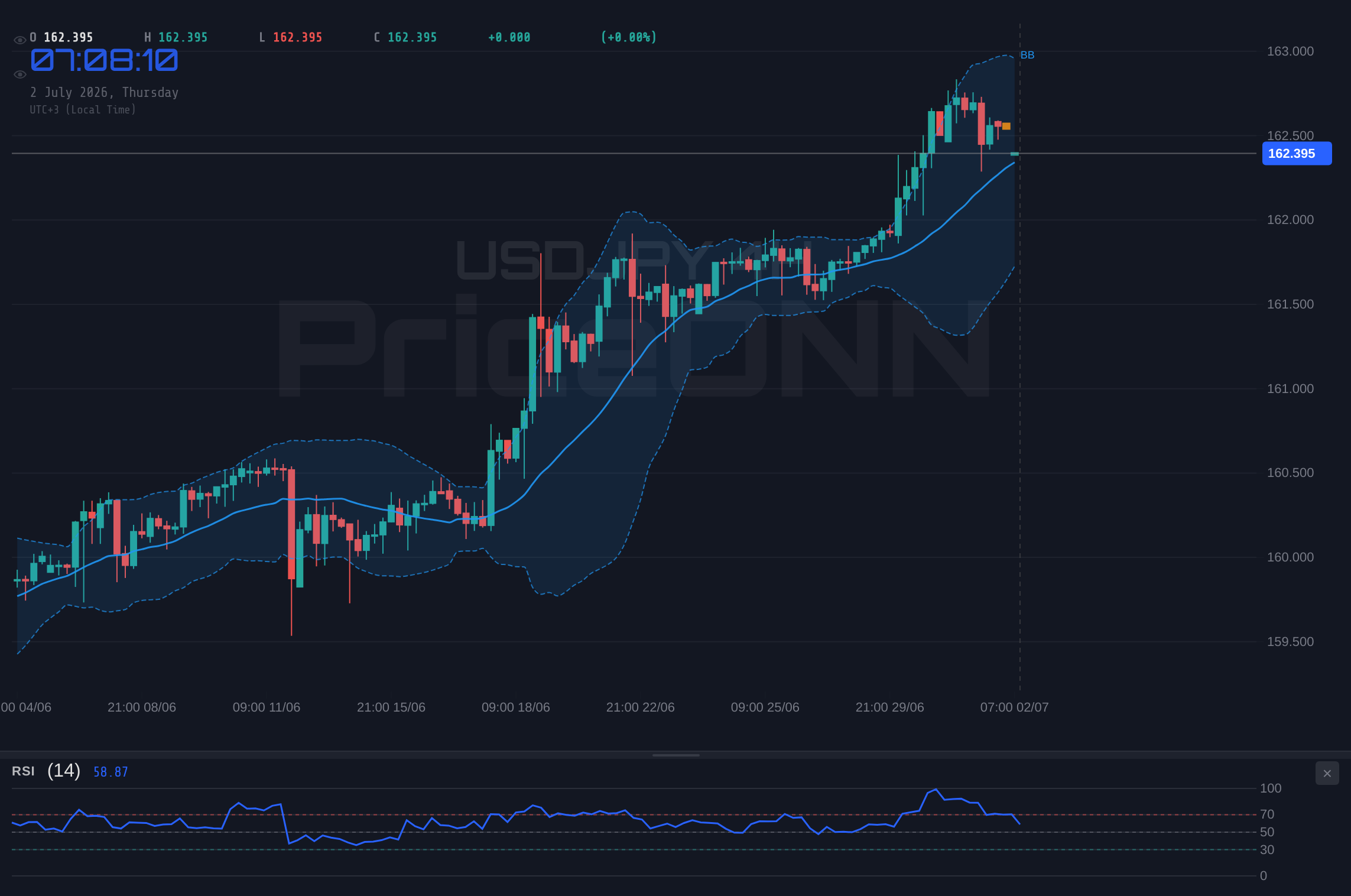
The 4-hour timeframe offers a more compelling bullish narrative, albeit with its own caveats. The trend is firmly established as bullish (Güç: 87%), supported by a strong ADX of 33.99. The RSI(14) sits at 59.58, comfortably in neutral territory and showing an upward tendency, suggesting further room for gains. The MACD is also positive, indicating upward momentum. However, the Stochastic oscillator (%K=49.37, %D=74.41) is showing a bearish signal, and more importantly, it's in the overbought zone. This suggests that while the trend is strong, the immediate upside might be limited, and a pullback could be on the cards. The Bollinger Bands are above the middle band, reinforcing the bullish trend, but the Stochastic's overbought reading is a red flag for immediate continuation.
The daily chart, as previously mentioned, presents the most significant divergence. The overall trend is classified as bullish with high power (96%), yet the RSI(14) at 75.19 is a stark warning of overbought conditions. This divergence is crucial. It suggests that the long-term trend might still be upwards, but the current price levels are stretched, making the pair vulnerable to significant pullbacks or consolidations. The MACD is positive, but the Stochastic is deep in overbought territory (%K=85.33, %D=90.84), reinforcing the overbought signal. The ADX at 31.54 indicates a strong uptrend, but when combined with the extremely high RSI and Stochastic, it signals that this trend is potentially overextended and at risk of reversal or a sharp correction.
Correlation Analysis: USDJPY's Dance with Global Markets
The USDJPY pair does not exist in a vacuum. Its movements are intrinsically linked to broader market forces, most notably the US Dollar Index (DXY). With the DXY currently showing a neutral trend on the 1-hour and 4-hour charts but a strong daily uptrend, the dollar's overall health is a key determinant. A rising DXY typically exerts downward pressure on USDJPY, as a stronger dollar makes it more expensive for yen holders to buy dollar-denominated assets. Conversely, a weakening DXY can provide support for USDJPY. Currently, the DXY's position around 101.38, while not exhibiting strong short-term directional momentum, carries the weight of a stronger daily trend, suggesting underlying dollar resilience that could cap further downside for USDJPY.
Beyond the dollar's performance, the broader market sentiment, often gauged by equity indices like the S&P 500 and Nasdaq, plays a critical role. The S&P 500, currently at 6572.87, shows a strong 1-hour and 4-hour uptrend, while its daily chart indicates a bearish trend. This mixed signal in equities suggests a degree of uncertainty in risk appetite. Typically, a risk-off environment (falling equities) can lead to a flight to safety, benefiting the Japanese Yen (JPY) and potentially weakening USDJPY. However, the current bullish momentum in the shorter timeframes for the S&P 500 might be providing some support to USDJPY, indicating that the pair might be less sensitive to risk-off sentiment at these specific levels, or that the dollar's strength is the dominant factor.
Oil prices, represented by Brent crude at $70.88, also offer valuable context. With Brent showing a strong downtrend across all timeframes and indicators suggesting oversold conditions, it signals potential weakness in global demand or a decrease in geopolitical risk premiums. While not directly correlated with USDJPY, a sustained drop in oil prices can sometimes be associated with a global economic slowdown, which could indirectly impact the JPY's safe-haven appeal. However, the current narrative for USDJPY seems more driven by interest rate differentials and dollar strength than by commodity price movements, making oil's influence more of a background factor at this moment.
The Crucial Role of Economic Data and Central Bank Policy
The Federal Reserve's monetary policy stance remains a central pillar in the USDJPY equation. While the market has largely priced in certain rate scenarios, any new data that shifts these expectations can cause significant price swings. The upcoming US Non-Farm Payrolls (NFP) report is paramount. If the job creation numbers significantly exceed expectations, it could reignite bets on further Fed tightening or a delayed pivot, strengthening the dollar and pushing USDJPY higher towards its resistance levels. Conversely, a disappointing NFP report might lead to a reassessment of Fed policy, potentially weakening the dollar and triggering a pullback in USDJPY, especially given the overbought signals on the daily chart.
Similarly, the Bank of Japan's (BoJ) policy remains a key consideration. While the BoJ has been on an ultra-loose monetary policy path, any hints of a shift, however subtle, could impact the Yen. The sheer widening of the interest rate differential between the US and Japan has been a major driver of USDJPY's ascent. Any indication from the BoJ that they might consider normalizing policy, even slightly, could lead to significant Yen appreciation. However, current market pricing and BoJ's historical stance suggest that such a shift is not imminent, allowing the interest rate differential to remain a supportive factor for the dollar's strength against the yen in the medium term.
The interplay between these fundamental drivers and the technical picture creates a high-stakes environment for USDJPY traders. The strong daily uptrend signal for the dollar, combined with a strong 4-hour uptrend for USDJPY, provides a bullish underpinning. However, the daily overbought RSI and Stochastic readings serve as a critical warning that the current rally is extended and vulnerable. This suggests that while a push towards resistance at $162.83 is possible, the probability of a significant pullback or consolidation increases substantially if key data points or central bank rhetoric do not provide further bullish impetus.
Trade Scenarios and Risk Management
Given the conflicting signals across different timeframes and the upcoming economic data, a scenario-based approach is essential for navigating USDJPY. The market is currently positioned at a critical resistance level, making it a pivotal moment for both bulls and bears. Understanding the potential outcomes and the conditions that would lead to them is key to managing risk effectively and identifying potential trading opportunities.
Bearish Scenario: Yen Strength Resurfaces
55% ProbabilityNeutral Scenario: Consolidation Around Resistance
30% ProbabilityBullish Scenario: Dollar Strength Dominates
15% ProbabilityThe Road Ahead: What to Watch
The immediate future for USDJPY hinges significantly on the upcoming US Non-Farm Payrolls report. A strong reading could propel the pair towards the $162.83 resistance and potentially higher, especially if it reinforces hawkish Fed expectations. However, the overbought conditions on the daily chart suggest that any rally might be met with profit-taking. Traders should be prepared for increased volatility around the data release. Key levels to monitor remain the immediate resistance at $162.83 and the support around $162.00. A decisive break above resistance, backed by strong data and dollar strength, could open the door for further upside. Conversely, a failure to break higher, coupled with weak data or a shift in Fed sentiment, could lead to a retracement towards daily support levels.
The correlation with the DXY will be critical. If the dollar index shows renewed strength, breaking above its daily uptrend resistance, it would lend significant weight to the bullish scenario for USDJPY. Conversely, any sign of dollar weakness, perhaps due to softening inflation data or a more dovish tone from Fed officials, could see USDJPY reverse course. The technical picture on the daily chart, with its overbought RSI and Stochastic, suggests that the market is ripe for a correction. Therefore, while a short-term push towards resistance is plausible, the risk of a deeper pullback increases if the bullish catalysts falter.
Ultimately, patience and discipline will be rewarded. The market is offering signals of both strength and potential exhaustion. Traders should focus on clear triggers and robust invalidation levels, rather than chasing the price. Managing risk by setting appropriate stop-losses and position sizing will be paramount, especially around the volatility expected from the NFP report. While the 4-hour chart shows bullish momentum, the daily overbought conditions cannot be ignored. The pair is at a crossroads, and the data yet to be released will likely provide the decisive direction.
Frequently Asked Questions: USDJPY Analysis
What happens if USDJPY breaks above $162.83 resistance with strong NFP data?
A strong NFP report combined with a break above $162.83 could signal further dollar strength, potentially pushing USDJPY towards the next daily resistance at $163.33. This scenario would be invalidated if price closes back below $162.00 or if the NFP data is weaker than expected.
Should I consider selling USDJPY at current levels near $162.45 given the daily RSI at 75.19?
Selling at current levels carries risk due to the strong 4-hour bullish trend. A more prudent approach might be to wait for confirmation of a bearish reversal, such as a close below $162.00 or a bearish divergence on shorter timeframes. The daily overbought RSI suggests vulnerability, but not an immediate sell signal without further confirmation.
Is the RSI at 75.19 a definitive sell signal for USDJPY right now?
An RSI reading of 75.19 on the daily chart indicates significant overbought conditions, suggesting the current uptrend is extended and vulnerable to a pullback. However, it is not a standalone sell signal; it needs to be confirmed by other indicators or price action, such as bearish divergence or a break of a key support level.
How will the upcoming US Non-Farm Payrolls report affect USDJPY trading this week?
A significantly stronger NFP report than expected could boost the dollar and push USDJPY higher towards $163.33, reinforcing Fed tightening expectations. Conversely, a weaker report might trigger a dollar sell-off and a pullback in USDJPY towards $161.74, as the market re-prices Fed policy.
Track markets in real-time
AI-powered analysis, technical indicators and real-time price data.
Join Our Telegram Channel
Breaking market news, AI analysis and trading signals instantly.
Join Channel