

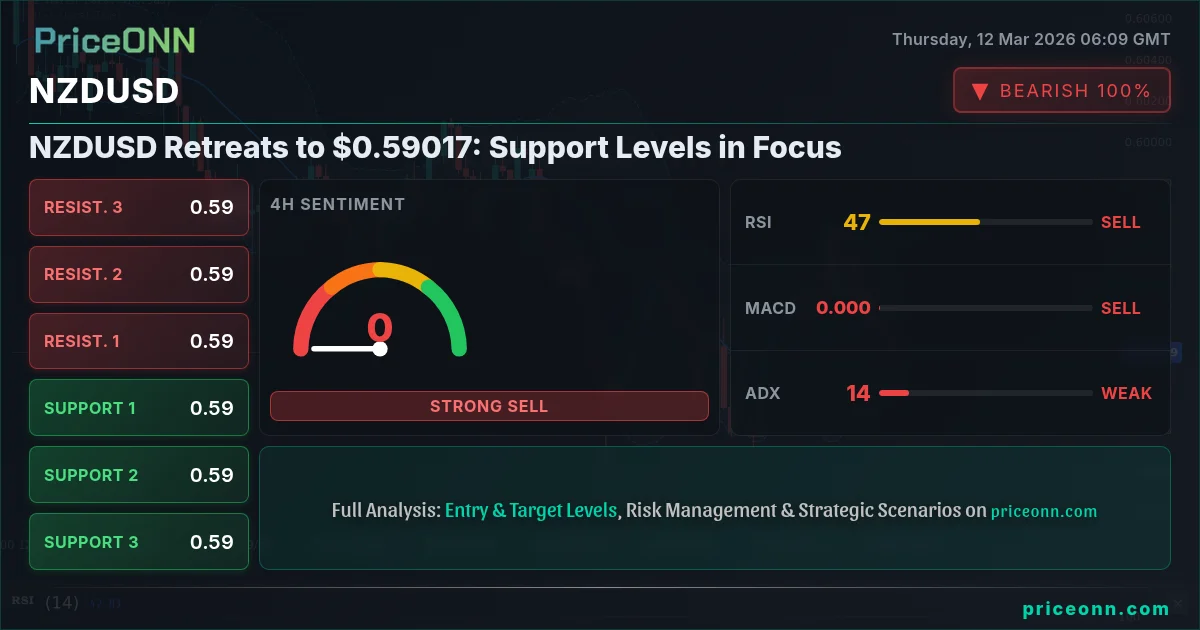
Kiwi is feeling the heat as NZDUSD retreats to $0.59017, testing key support levels. Is this a temporary pullback or the start of a deeper correction? The answer lies in understanding the interplay between technical signals and a strengthening US dollar.
- RSI at 39.97 on the 1H chart signals weakening bullish momentum.
- Immediate support is being tested at $0.5895, a break below opens the door to $0.58916.
- The DXY's rise to 99.2 is putting downward pressure on NZDUSD.
- Watch for Friday's GBP economic data which could indirectly influence NZDUSD sentiment.
Having tracked NZDUSD through several market cycles, I've learned that these pullbacks often present opportunities for patient traders. The key is to identify the underlying drivers and confirm the technical signals before making a move. Today, we'll dissect the technical picture, assess the impact of a strengthening dollar, and identify potential trade setups.
Kiwi Under Pressure: What's Driving the Downtrend?
The primary culprit behind NZDUSD's recent decline is a strengthening US dollar, as indicated by the DXY's rise to 99.2. A stronger dollar typically puts downward pressure on currency pairs like NZDUSD. The question is whether this dollar strength is sustainable, or if it's a temporary phenomenon.
On the fundamental front, the market is digesting recent economic data and anticipating upcoming releases. While specific USD data releases occurred this week, the market's risk sentiment is being driven by rising oil prices. The recent jump in oil prices, with Brent at $98.6 and WTI at $93.15, is heightening inflation fears, which in turn supports the dollar. As crude oil eyes $90, Iran tensions may threaten Eurozone stability. Friday’s GBP economic data may also affect the market’s risk appetite.
Technical Breakdown: Support Levels and Indicator Readings
From a technical perspective, NZDUSD is currently trading at $0.59017, testing immediate support. A break below this level could lead to further declines. The 1H chart reveals a neutral trend, but the ADX at 20.03 suggests that the current downtrend has some momentum behind it. The RSI(14) is at 39.97, indicating that the pair is not yet oversold, leaving room for further downside.
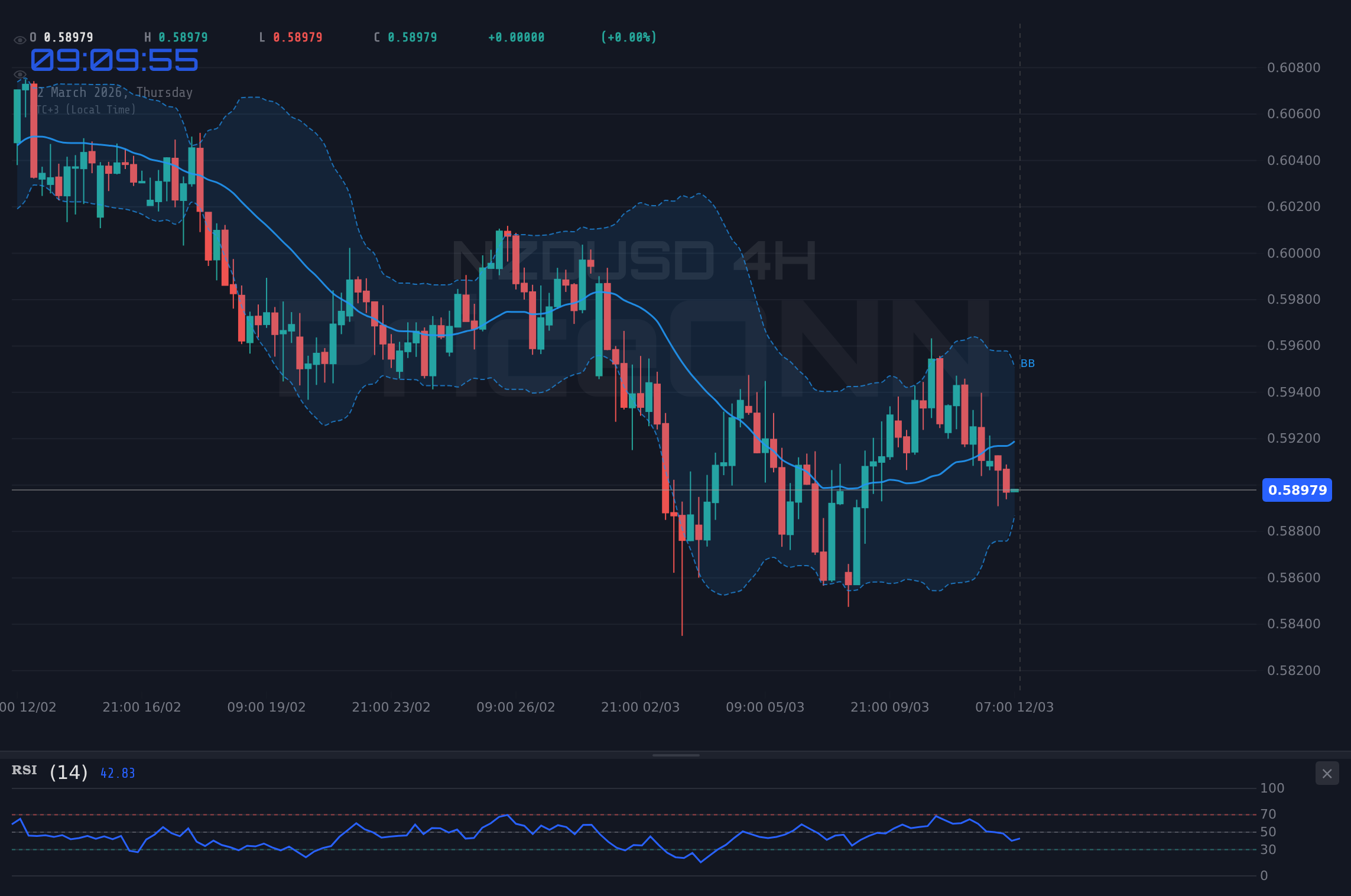
Zooming out to the 4H timeframe, the picture remains bearish. The RSI(14) is at 44.22, still in neutral territory, and the MACD histogram is negative, suggesting continued selling pressure. Key support levels to watch on this timeframe are $0.5894, $0.58815 and $0.58721. A break below $0.5894 could trigger a sharper sell-off.
The daily chart offers a slightly more nuanced perspective. While the overall trend is neutral, the Stochastic K=45.74 crosses above D=44.14, generating a bullish signal. However, the RSI(14) is at 43.85, indicating that the underlying momentum is still weak. Key support on the daily chart lies at $0.58937, followed by $0.58771.
Why $0.5895 is the Line in the Sand
The $0.5895 level represents a critical juncture for NZDUSD. This level aligns with the 1H chart's first support and is close to the 4H chart's first support. A sustained break below this level would confirm the bearish thesis and open the door for a test of the subsequent support levels. Conversely, a bounce from this level could signal a temporary reprieve and a potential retest of resistance.
The weak ADX reading across multiple timeframes is the real story here. A weak-trend reading like this means the breakout hasn't committed yet-it could go either way. This is why a close watch on price action around $0.5895 is warranted.
Potential Trade Setups: A Waiting Game
Given the conflicting signals and the choppy market conditions (ADX 15.26), the current recommendation is to remain in a WATCH_ZONE. While the RSI and MACD histogram are aligned, providing a clear directional signal, the Stochastic is not in extreme territory, suggesting that the pair could consolidate before making its next move.
A potential trade setup would emerge if NZDUSD breaks decisively above the 1H chart's first resistance at $0.59039. A daily close above $0.59039 would open the door for a test of the subsequent resistance levels at $0.59094 and $0.59128. However, traders should exercise caution and wait for confirmation before entering any positions.
Alternatively, a sustained break below the 1H chart's first support at $0.5895 could signal a continuation of the downtrend. In this case, traders could look for shorting opportunities with a target at the next support levels. However, it's crucial to manage risk and set appropriate stop-loss levels.
The Big Picture: Macro Drivers and Geopolitical Risks
Looking beyond the technicals, it's essential to consider the broader macro drivers and geopolitical risks that could influence NZDUSD. As mentioned earlier, the strength of the US dollar is a key factor. Any changes in Federal Reserve policy or economic data releases could significantly impact the dollar's trajectory and, consequently, NZDUSD.
Geopolitical tensions in the Middle East are also worth monitoring. As reported by news outlets, escalating tensions in the region have caused crude oil prices to surge, fueling fears of rising inflation. This, in turn, could lead to a more hawkish stance from central banks, further supporting the dollar. The impact of these tensions on global trade and economic growth could also affect the New Zealand dollar, which is often seen as a risk-on currency.
Frequently Asked Questions: NZDUSD Analysis
What happens if NZDUSD breaks below $0.5895 support?
A break below the $0.5895 support level could trigger a sharper sell-off, potentially leading to a test of the subsequent support levels at $0.58916 and $0.58861 on the 1H chart. This scenario would confirm the bearish thesis and suggest a continuation of the downtrend.
Should I buy NZDUSD at current levels of $0.59017 given the RSI at 39.97?
While the RSI at 39.97 suggests that NZDUSD is approaching oversold territory, it's not yet a clear buy signal. The RSI is still in neutral territory, and the MACD histogram is negative, indicating continued selling pressure. Traders should wait for confirmation of a bullish reversal before entering any long positions.
Is the negative MACD histogram a strong sell signal for NZDUSD?
The negative MACD histogram indicates that selling pressure is still present in the market. However, it's important to consider the MACD in conjunction with other indicators. If the MACD crosses above its signal line and the RSI starts to rise, it could signal a potential bullish reversal.
How will Friday's GBP economic data affect NZDUSD this week?
Friday's GBP economic data releases could indirectly influence NZDUSD by affecting overall market risk sentiment. Positive data could boost risk appetite, potentially supporting the New Zealand dollar. Conversely, negative data could weigh on risk sentiment and support the US dollar, putting downward pressure on NZDUSD.
Track markets in real-time
AI-powered analysis, technical indicators and real-time price data.
Join Our Telegram Channel
Breaking market news, AI analysis and trading signals instantly.
Join Channel